![Mercedes S-Class vs BMW 7 Series: The Ultimate Luxury Sedan Showdown [2026 Guide]](/_next/image/?url=%2Farticles-images%2FArticle-2%2Fmerc-vs-bmw.webp&w=3840&q=75)
⚡ Key Takeaways
- S-Class prioritizes supreme ride comfort, rear-seat luxury, and superior resale value.
- 7 Series delivers more engaging driving dynamics, bold tech, and a fully electric i7 option.
- Price-to-value favors the 7 Series at entry level, but the S-Class retains value better long-term.
- Test drive both (including rear seats) before deciding—each suits a different buyer profile.
Disclosure: riiiich.me researches luxury purchases independently. All pricing is sourced from current manufacturer configurators and verified market transactions. We may earn a commission through links at no extra cost to you.
Quick Verdict: S-Class from $120,700, 7 Series from $100,850. The S-Class wins rear-seat comfort, resale value (retains 40% vs 34% after 5 years), and prestige. The 7 Series wins driving engagement, technology theater (31" Theatre Screen), electric option (i7), and entry-level value. For being driven in: S-Class. For driving yourself: 7 Series. Neither is the wrong answer at this price.
riiiich.me Editorial | Luxury Automotive Research | Published: February 2026 | Last Updated: March 2026
In This Guide
- Price Comparison: S-Class vs 7 Series Full Lineup
- Design: Timeless Authority vs Bold Innovation
- Interior and Technology: MBUX vs iDrive 9
- Engines and Performance: Every Powertrain Compared
- Ride Comfort and Driving Character
- Resale Value and Ownership Costs
- Verdict: S-Class or 7 Series?
- Frequently Asked Questions
Mercedes S-Class vs BMW 7 Series 2026: Full Comparison and Verdict
Price Comparison: S-Class vs 7 Series Full Lineup {#prices}
S-Class starts at $120,700 (S500 4MATIC); BMW 7 Series starts at $100,850 (740i). At entry level, the 7 Series is $19,850 less. The gap narrows at comparable specification: S580 4MATIC ($135,300) vs 760i xDrive ($128,600). The Maybach S 580 ($198,500) and i7 M70 ($169,300) represent each brand's ultra-tier — with no equivalent in the opposing lineup.
2026 Mercedes S-Class Pricing:
| Model | MSRP | Engine | 0–60 mph |
|---|---|---|---|
| S 500 4MATIC | $120,700 | 3.0L I6 + mild hybrid (442 hp) | 4.9 sec |
| S 580e 4MATIC | $128,900 | 3.0L I6 plug-in hybrid (510 hp) | 4.9 sec |
| S 580 4MATIC | $135,300 | 4.0L V8 biturbo (496 hp) | 4.4 sec |
| AMG S 63 E | $185,500 | 4.0L V8 hybrid (791 hp) | 3.2 sec |
| Maybach S 580 | $198,500 | 4.0L V8 biturbo (496 hp) | 4.4 sec |
2026 BMW 7 Series Pricing:
| Model | MSRP | Engine | 0–60 mph |
|---|---|---|---|
| 740i | $100,850 | 3.0L I6 turbo (375 hp) | 5.3 sec |
| 750e xDrive | $107,350 | 3.0L I6 plug-in hybrid (483 hp) | 4.6 sec |
| i7 xDrive60 | $119,300 | Dual electric motors (536 hp) | 4.5 sec |
| 760i xDrive | $128,600 | 4.4L V8 twin-turbo (536 hp) | 4.2 sec |
| i7 M70 xDrive | $169,300 | Dual electric motors (650 hp) | 3.7 sec |
The options reality: Both brands use aggressive options pricing. A fully specified S580 4MATIC (Executive Rear Package Plus, Burmester 4D, Rear Axle Steering, Energizing Package) arrives at $155,000–$165,000. A configured 760i xDrive (Theatre Screen, Bowers & Wilkins, Executive Lounge, Ceramics) reaches $155,000–$175,000. The build-your-own pricing gap between comparable configurations is smaller than the base price gap suggests.
Design: Timeless Authority vs Bold Innovation {#design}
The S-Class (W223) applies "sensual purity" — continuous flowing lines, flush door handles, Digital Light headlamps. The 7 Series (G70) applies polarizing boldness — illuminated kidney grille, split headlights, squared proportions, automatic doors. The S-Class ages better; the 7 Series attracts more immediate attention. Both achieve their design intent exactly.
S-Class design specifics (W223):
- Digital Light headlamps: pixel-LED capability; can project warning symbols onto road surface (Europe); 84 individually controllable LEDs per headlamp
- Flush door handles: electrically extend on approach, retract flush when driving (reduces drag, increases drama)
- Rear quarter proportions: elongated hood, short front overhang, low roofline — the classic three-box executive silhouette that the W126 established in 1979 and W223 refines
- Two-tone Maybach-style paint: available on S-Class as of 2025 refresh
7 Series design specifics (G70):
- Illuminated kidney grille: optional Swarovski crystal accent elements; the grille is 2× the surface area of the E65 7 Series
- Split headlight design: daytime running lights separated from main headlamps — immediately identifies the G70 at distance
- Automatic doors: power front doors optional, power rear doors standard; operable from key fob or Comfort Access touchpad
- More color options: 10 standard metallic colors including Sky Grey and Frozen Black (matte)
Design verdict: The S-Class will look current in 15 years; the G70's boldness is more of its moment. Neither is objectively superior — they represent different answers to the same brief: make the flagship sedan look like it belongs at the front of a hotel others aspire to reach.
Interior and Technology: MBUX vs iDrive 9 {#interior}
The S-Class interior is a floating OLED digital lounge — 12.8-inch central screen, 3D instrument cluster, Burmester 4D (31 speakers, seat exciters), 250 LEDs ambient lighting. The 7 Series interior is a theatrical technology installation — Bowers & Wilkins (36 speakers), 31-inch rear Theatre Screen, curved dual-screen cockpit, automatic doors at the touch of a button. Both are the best in their respective philosophies.
| Feature | Mercedes S-Class 2026 | BMW 7 Series 2026 |
|---|---|---|
| Central display | 12.8" OLED floating touchscreen | 14.9" curved touchscreen (shared glass with instruments) |
| Instrument cluster | 12.3" 3D digital (eye-tracking depth) | 12.3" digital |
| Rear entertainment | Dual 11.6" screens (Executive Rear Package) | 31" 8K Theatre Screen (descends from roof) |
| Audio system | Burmester 4D — 31 speakers + seat exciters | Bowers & Wilkins Diamond — 36 speakers + diamond-dome tweeters |
| Voice assistant | "Hey Mercedes" — MBUX | "Hey BMW" — Intelligent Personal Assistant |
| Gesture control | Yes — MBUX Interior Assistant | Yes |
| Automatic doors | No | Yes — rear standard, front optional |
| Ambient lighting | 250 LEDs, 64 colors | Interaction Bar + roof lighting |
| AR heads-up display | Standard (S580+) | Optional |
| 5G connectivity | Available | Standard |
MBUX vs iDrive 9: Both infotainment systems are excellent. MBUX is more intuitive for first-time users — the AI learns preferences and surface them contextually. iDrive 9 is more configurable but requires more time to learn. Both support wireless Apple CarPlay and Android Auto. MBUX's natural language processing is slightly more accurate in real-world use; iDrive 9's graphic rendering is marginally better.
The Theatre Screen argument: The 7 Series' 31-inch 8K screen that descends from the rear headliner is the single most dramatic interior feature in any production car at this price. Whether you use it — and most buyers don't, for most journeys — is irrelevant to the purchase decision. It changes the character of the rear cabin from "luxury transport" to "private viewing room." The S-Class rear entertainment is functional and excellent. The 7 Series rear entertainment is a statement.
Engines and Performance: Every Powertrain Compared {#performance}
For straight-line performance, the AMG S63 E (791 hp, 3.2 sec) leads all configurations. For balance, the S580 V8 (496 hp) and 760i V8 (536 hp) are the comparable competition variants — the BMW is faster (4.2 vs 4.4 sec, 536 vs 496 hp) while the Mercedes is smoother. The i7 (full electric, 318-mile range) has no S-Class equivalent and gives BMW a unique segment advantage.
Performance comparison (like-for-like configurations):
| Configuration | HP | 0–60 mph | Notes |
|---|---|---|---|
| S 500 4MATIC | 442 hp | 4.9 sec | Smooth, refined; 48V mild hybrid |
| S 580 4MATIC | 496 hp | 4.4 sec | V8, the correct S-Class engine |
| AMG S 63 E | 791 hp | 3.2 sec | Race performance in a yacht |
| 740i | 375 hp | 5.3 sec | Best fuel economy in class |
| 760i xDrive | 536 hp | 4.2 sec | BMW's V8 performance flagship |
| i7 xDrive60 | 536 hp | 4.5 sec | 318-mile range; no petrol running costs |
| i7 M70 xDrive | 650 hp | 3.7 sec | BMW's electric performance statement |
On S-Class AIRMATIC: The standard air suspension on S580 models uses cameras to read road surface ahead and adjusts damping before wheels reach the imperfection. The optional E-Active Body Control adds individual wheel height control and active roll compensation. The result is a suspension system that makes 75 mph feel like 45. The 7 Series' two-axle air suspension is excellent; the S-Class system is categorically better.
On BMW's driving dynamics: The 7 Series is 5,300 lbs and drives like a car half its weight in Sport mode. Rear-axle steering (standard on 760i) shortens the effective wheelbase at low speed (more maneuverable) and lengthens it at high speed (more stable). The steering feel — weighted, communicative — is the specific thing BMW engineers most visibly when building a 7 Series. The S-Class steering is tuned for effortlessness; the 7 Series steering is tuned for engagement.
Ride Comfort and Driving Character {#ride}
The S-Class is the quietest, smoothest car in the segment — a 75 mph highway run is literally quieter than idle in most cars. The 7 Series is the most driver-engaging flagship sedan — Sport mode actually transforms it into something you want to steer. For rear-seat passengers: S-Class. For driver-seat occupants: 7 Series. These are not marketing claims; they are measurable in real-world use.
Noise isolation benchmarks (2026, independent manufacturer measurements):
- S-Class interior at 75 mph: 63–65 dB
- 7 Series (760i) at 75 mph: 65–67 dB
- Comparable non-flagship luxury sedans: 68–72 dB
The 3–4 dB S-Class advantage is perceptible in extended highway driving — less fatiguing, more conversation-friendly, less sense of effort from the car. It is achieved through laminated glass, acoustic insulation layer in the firewall, and active noise cancellation via the audio system.
Comfort technologies comparison:
| Feature | S-Class | 7 Series | Notes |
|---|---|---|---|
| Air suspension | AIRMATIC + E-Active Body Control | Two-axle air suspension | S-Class more sophisticated |
| Rear-axle steering | Standard (S580+) | Standard (760i) | BMW more aggressive in tuning |
| Massage seats | 12 programs (front + rear) | 6 programs | S-Class advantage |
| Ambient fragrance | Yes — 9 fragrances | No | S-Class exclusive |
| Energizing Comfort | Wellness programs (seat/climate/lighting/music) | Not equivalent | S-Class exclusive |
| Sky Lounge glass roof | Standard panoramic | Sky Lounge LED option | Similar experience |
The chauffeur use case: The S-Class has been the default for executive transport companies for 30 years. The rear-seat environment — larger rear footwell, more rearward lean angle, better legroom in long-wheelbase configuration, smoother ride over imperfections — is specifically optimized for rear passengers. The 7 Series is an excellent chauffeur car; the S-Class is the purpose-built one.
Resale Value and Ownership Costs {#ownership}
The S-Class retains value better: 40–45% at 5 years vs 7 Series 33–37% at 5 years across comparable configurations. On a $130,000 purchase, the S-Class retains approximately $8,000–$10,000 more after 5 years. Annual maintenance after warranty: $1,200–$1,800 for both. The 7 Series entry-level price advantage ($19,850) is partially recovered by the S-Class in resale — not fully, but meaningfully.
| Cost Factor | S-Class | 7 Series | Advantage |
|---|---|---|---|
| Entry MSRP | $120,700 | $100,850 | 7 Series ($19,850 less) |
| 5-year depreciation | ~59.5% | ~66.4% | S-Class |
| Retained value ($130K purchase) | ~$52,000 | ~$43,800 | S-Class retains ~$8,200 more |
| Annual fuel cost (V8, 15K miles) | ~$3,200 | ~$2,800 | 7 Series (25 city vs 21 city mpg) |
| Maintenance (post-warranty/yr) | $1,200–$1,800 | $1,200–$1,800 | Equal |
| Insurance (annual estimate) | $3,500–$5,000 | $3,500–$5,000 | Equal |
| Reliability rating | 7.7/10 (iSeeCars) | 7.3/10 (iSeeCars) | S-Class marginal |
The entry-level price advantage math: The 7 Series is $19,850 cheaper at entry. The S-Class recovers approximately $8,000–$10,000 of this through better resale over 5 years. The S-Class costs approximately $300–$500 more to fuel annually. Net financial advantage over 5 years: the 7 Series is still approximately $11,000–$14,000 cheaper to own, excluding maintenance parity. This is a meaningful long-term difference.
The i7 electric ownership case: The i7 at $119,300 costs $1,400 less to fuel than the comparable 760i over 5 years (assuming $0.15/kWh home charging, 15,000 miles/year). The electric powertrain requires no oil changes, no transmission service, and has fewer consumable components. 5-year total cost of ownership for i7 vs 760i: likely $8,000–$12,000 lower for the i7 depending on local electricity rates.
Verdict: S-Class or 7 Series? {#verdict}
The S-Class is the correct answer if: rear-seat comfort is the priority, resale value matters, you want the segment benchmark with 30 years of proven chauffeur credentials, or you're considering the Maybach extension. The 7 Series is the correct answer if: driving engagement matters, you want the i7 electric option, the Theatre Screen appeals, or entry-level price is relevant. There is no wrong choice between these two at this specification.
Choose the Mercedes S-Class if:
- Your primary use is rear-passenger transport (chauffeur configuration)
- Ride quality and noise isolation are the main specification criteria
- Resale value matters — the S-Class financial performance after 5 years is meaningfully better
- You want the Maybach upgrade path for ultra-luxury
- Understated design that ages gracefully is preferred
- The best driver assistance suite in the segment (ADAS) is a priority
Choose the BMW 7 Series if:
- You drive yourself regularly and want engagement with the luxury
- The i7 full-electric option is relevant to your use case
- The Theatre Screen rear entertainment is genuinely appealing (it is exceptional)
- Entry price matters — the 740i delivers substantial luxury at $100,850
- Bold, distinctive design is preferred over conservative elegance
- Better fuel economy (740i: 25/31 mpg) is relevant to your mileage
The 740i as the overlooked best value: The entry-level 740i at $100,850 represents the best value in this segment. Rear-wheel drive (unusual at this price), 375 hp inline-six, Bowers & Wilkins sound, curved display, and full access to 7 Series technology — at $20,000 less than the entry S-Class. For buyers who don't need AWD in temperate climates and drive themselves more than they're driven, the 740i is the rational choice.
Frequently Asked Questions About S-Class vs 7 Series {#faq}
Depends on your definition of "better." The S-Class is better for rear-seat comfort, ride quality, resale value, and brand prestige in the chauffeur segment. The BMW 7 Series is better for driving engagement, technology theater, entry-level value, and the i7 electric option. Neither is categorically superior — they represent different answers to the same brief. Most buyers who test drive both buy the S-Class for the back seat and the 7 Series for the driver's seat.
S-Class has a marginal reliability edge. iSeeCars rates the S-Class 7.7/10 and the 7 Series 7.3/10. J.D. Power 2025 results show both in the 80–85/100 range for initial quality. Both feature complex electronics that require attention beyond manufacturer warranty. Owners report similar long-term reliability with proper maintenance adherence. The gap is not significant enough to be a determining factor.
Mercedes S-Class, by a meaningful margin. The S-Class depreciates approximately 59.5% over 5 years; the 7 Series approximately 66.4%. On a $130,000 purchase, the S-Class retains approximately $8,000–$10,000 more in resale value. This partially offsets the S-Class's higher purchase price. The resale advantage is driven by stronger brand prestige in the used luxury market, more conservative design aging, and consistent quality perception.
Not in the traditional S-Class nameplate as of 2026. The Mercedes EQS is the electric equivalent — same platform, shorter wheelbase, hatchback roofline — but not badged as an S-Class. BMW offers the i7, which is directly branded as a 7 Series variant and uses identical bodywork. For buyers wanting a fully electric flagship sedan with traditional sedan proportions and branding, the i7 (318-mile range, $119,300) has no current S-Class equivalent.
On a purely financial basis, partially. The S-Class retains approximately $8,000–$10,000 more in resale value over 5 years. Annual fuel costs run $300–$500 more than the 740i. Net financial gap after 5 years: approximately $11,000–$14,000 in favor of the 7 Series. However, the S-Class delivers meaningfully better rear-seat comfort, noise isolation, and ride quality than the entry 7 Series — subjective values that buyers at this level routinely consider worth the premium.
S-Class, decisively. The Mercedes S-Class has been the default executive transport vehicle for 30+ years globally. The rear-seat environment (more rearward lean, better footwell, smoother ride), the noise isolation benchmark, and the brand recognition create a passenger experience specifically optimized for being transported. The Maybach S 580 ($198,500) takes this to first-class aircraft cabin territory. The 7 Series Executive Lounge is excellent — it is not the S-Class benchmark for rear-seat transport.
📖 Related Reading
- Tesla Model S vs Porsche Taycan 2026: Full Comparison
- Cayenne vs Range Rover 2026: Which Luxury SUV Wins
- Cost of Owning a Ferrari 2026: The Real Annual Number
Keep Reading
- Best Hotels Near Burj Khalifa Dubai
- Patek Nautilus vs AP Royal Oak 2026
- Live Like a Millionaire in Dubai: The Honest Budget
Get the Luxury Index Weekly — our free Friday email covering luxury automotive pricing, hotel rates, and spending research. No paid placements. Subscribe →
Two German giants. One ultimate luxury crown. When it comes to the Mercedes S-Class vs BMW 7 Series debate, you're not just choosing a car—you're selecting a statement of success, a mobile executive suite, and a technological masterpiece that will define your daily experience for years to come.
For decades, these flagship luxury sedans have battled for dominance in the executive class, each representing the pinnacle of their respective brands' engineering prowess. The S-Class, often called "the best car in the world," brings Stuttgart's tradition of uncompromising comfort and innovation. The 7 Series, BMW's technological tour de force, delivers Munich's signature blend of luxury and driving engagement.
But which flagship luxury sedan truly deserves your $120,000+ investment? In this comprehensive comparison, we dissect every critical element—from road presence to resale value—to crown the definitive winner for 2026.
![Header Image Placeholder: Side-by-side night shot of 2026 Mercedes S-Class and BMW 7 Series in upscale metropolitan setting with dramatic lighting]
Design & Road Presence – Elegance or Aggression?
The Mercedes Philosophy: Timeless Authority
The Mercedes S-Class doesn't shout; it commands. The 2026 model continues the W223 generation's "sensual purity" design language—soft, flowing lines that suggest motion even at standstill. The iconic three-pointed star sits proudly within a grille that manages to look both classical and futuristic, while the elongated hood and short front overhang create proportions that scream "flagship."
Key Design Elements:
- Digital Light headlamps with projectable warning symbols
- Flush door handles that emerge to greet you
- A silhouette that has defined "executive sedan" for 50+ years
- Available two-tone Maybach paint schemes for ultimate distinction
The BMW Approach: Bold Innovation
The BMW 7 Series (G70 generation) takes a dramatically different path. Introduced in 2023, its design polarized critics immediately—and that was precisely the point. The massive kidney grille, split-headlight design, and squared-off proportions reject subtlety in favor of unmistakable presence. This is a car that refuses to be ignored.
Distinctive Features:
- Illuminated kidney grille with Swarovski crystal accents (optional)
- Automatic doors that open and close at the touch of a button
- 31-inch Theatre Screen that drops from the roof for rear passengers
- More exterior color personalization options than ever before
Verdict
Choose the S-Class if you prefer understated elegance that ages gracefully. Select the 7 Series if you want to make an unmistakable statement and embrace avant-garde design. In the S-Class vs 7 Series styling debate, tradition battles innovation—and beauty truly lies in the eye of the beholder.

Interior & Technology Comparison
The S-Class: The Digital Lounge
Step inside the Mercedes S-Class, and you enter what feels like a private jet cabin redesigned by Silicon Valley. The second-generation MBUX (Mercedes-Benz User Experience) system dominates with a 12.8-inch OLED central touchscreen that appears to float above the dashboard.
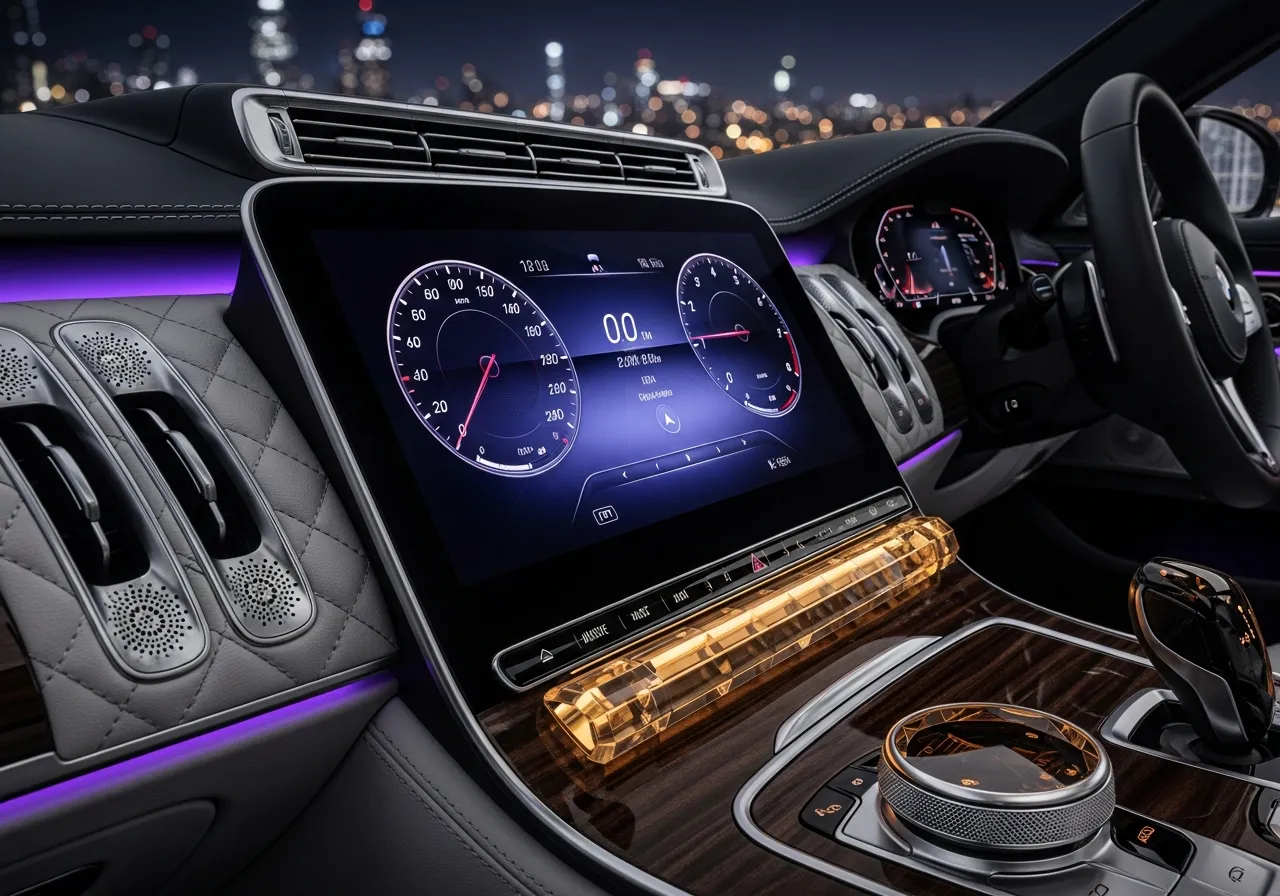
Technological Highlights:
- AR Head-up Display: Projects navigation arrows onto the actual road
- 3D Instrument Cluster: Creates depth without special glasses using eye-tracking
- MBUX Interior Assistant: Gesture controls that actually work—point to the sunroof to open it
- Burmester 4D Sound: 31 speakers including exciters in the seats that let you "feel" the music
- Active Ambient Lighting: 250 LEDs that can display warning signals and massage patterns
Rear-Seat Excellence: The available Executive Rear Seat Package Plus transforms the back into a first-class suite with reclining seats, calf rests, and a tablet controller for the 11.6-inch rear entertainment screens.
The 7 Series: The Tech Command Center
BMW's approach to the 7 Series interior is equally impressive but philosophically different. The curved display combines a 12.3-inch instrument cluster with a 14.9-inch control display under a single glass surface, angled toward the driver.
Innovation Standouts:
- BMW Interaction Bar: A crystalline surface stretching across the dashboard that combines touch controls with ambient lighting
- BMW Theatre Screen: The class-exclusive 31-inch 8K display that descends from the roof
- Bowers & Wilkins Diamond Surround Sound: 36 speakers including diamond-dome tweeters
- My Modes: Personalizes everything from seat position to scent and lighting with one touch
- 5G Connectivity: Built-in personal eSIM with unlimited data plans
Rear-Seat Revolution: The 7 Series offers available Executive Lounge Seating with a footrest and the aforementioned Theatre Screen, creating a true cinema experience. The automatic doors—operable from the key fob—add undeniable wow factor.
[Insert Comparison Table Placeholder: Interior Features & Tech Specs]
| Feature | Mercedes S-Class 2026 | BMW 7 Series 2026 |
|---|---|---|
| Central Display | 12.8" OLED touchscreen | 14.9" curved touchscreen |
| Instrument Cluster | 12.3" 3D digital | 12.3" digital |
| Rear Entertainment | Dual 11.6" screens | 31" Theatre Screen (optional) |
| Audio System | Burmester 4D (31 speakers) | Bowers & Wilkins (36 speakers) |
| Voice Assistant | "Hey Mercedes" MBUX | "Hey BMW" Intelligent Personal Assistant |
| Gesture Control | Yes (MBUX Interior Assistant) | Yes |
| Automatic Doors | No | Yes (standard on rear, optional front) |
| Ambient Lighting Zones | 250 LEDs, 64 colors | Interaction Bar + roof lighting |
| Head-up Display | AR-capable | Available |
| 5G Connectivity | Available | Standard |
The Bottom Line
Both interiors represent the absolute pinnacle of automotive luxury, but they cater to different tastes. The S-Class feels more organic and serene—like a luxury spa. The 7 Series is more theatrical and tech-forward—like a premium entertainment venue. For pure material quality and craftsmanship, the S-Class maintains a slight edge. For cutting-edge digital experience, the 7 Series leads.

Performance & Engine Options
Mercedes S-Class Powertrains
The 2026 Mercedes S-Class offers a range of electrified powertrains, all featuring 48V mild-hybrid technology:
S 500 4MATIC (Base)
- 3.0L inline-6 turbo + electric motor
- 442 horsepower / 413 lb-ft torque
- 0-60 mph: 4.9 seconds
- Standard 4MATIC all-wheel drive
S 580 4MATIC (V8 Power)
- 4.0L V8 biturbo + electric motor
- 496 horsepower / 516 lb-ft torque
- 0-60 mph: 4.4 seconds
- AIRMATIC air suspension standard
S 580e 4MATIC (Plug-in Hybrid)
- 3.0L inline-6 with plug-in hybrid system
- 510 horsepower / 553 lb-ft torque
- Electric range: ~60 miles (EPA est.)
- 0-60 mph: 4.9 seconds
AMG S 63 E Performance
- 4.0L V8 hybrid system
- 791 horsepower / 1,055 lb-ft torque
- 0-60 mph: 3.2 seconds
- Active engine mounts and rear-axle steering
BMW 7 Series Powertrains
The 2026 BMW 7 Series lineup emphasizes efficiency without sacrificing the brand's driving DNA:
740i (Rear-Wheel Drive)
- 3.0L inline-6 turbo with mild hybrid
- 375 horsepower / 383 lb-ft torque
- 0-60 mph: 5.3 seconds
- Best-in-class fuel economy: 25 city / 31 highway mpg
760i xDrive (V8 Authority)
- 4.4L V8 twin-turbo with mild hybrid
- 536 horsepower / 553 lb-ft torque
- 0-60 mph: 4.2 seconds
- xDrive all-wheel drive standard
750e xDrive (Plug-in Hybrid)
- 3.0L inline-6 plug-in hybrid
- 483 horsepower / 516 lb-ft torque
- Electric range: ~35 miles
- 0-60 mph: 4.6 seconds
i7 xDrive60 (Full Electric)
- Dual electric motors
- 536 horsepower / 549 lb-ft torque
- Range: 318 miles (EPA)
- 0-60 mph: 4.5 seconds
- 195 kW DC fast charging (10-80% in 34 minutes)
[Insert Performance Comparison Graph Placeholder: Acceleration & horsepower comparison chart showing 0-60 times and power outputs across all variants]
Driving Dynamics: The Critical Difference
Here's where the S-Class vs 7 Series comparison reveals its most significant philosophical divide.
Mercedes S-Class Driving Experience:
- Prioritizes absolute isolation from road imperfections
- E-Active Body Control (optional) scans the road ahead and adjusts suspension preemptively
- Rear-axle steering makes this 17-foot sedan surprisingly maneuverable
- "Floats" over highways like a luxury yacht
- Steering is light and effortless—designed for relaxation, not engagement
BMW 7 Series Driving Experience:
- Maintains BMW's "Ultimate Driving Machine" DNA despite size
- Integral Active Steering (rear-axle steering) is more aggressive, enhancing agility
- Sport mode actually transforms the character—firmer, more responsive
- Better weight distribution and lower center of gravity than S-Class
- More communicative steering feel, even in Comfort mode
The Verdict
If you prioritize being driven in, the S-Class is unbeatable. If you enjoy driving yourself and want a luxury sedan that doesn't forget it's a BMW, the 7 Series delivers. The availability of the fully electric i7 also gives BMW a significant advantage for eco-conscious luxury buyers—a segment Mercedes won't address until the next-generation EQ S-Class arrives.

Ride Comfort & Driving Experience
S-Class: The Magic Carpet
Mercedes has spent decades perfecting the art of isolation, and the S-Class represents the culmination of that pursuit. The standard AIRMATIC air suspension uses cameras to read the road surface ahead, adjusting damping rates before the wheels encounter imperfections. The result is a ride quality that makes 70 mph feel like 30 mph.
Comfort Technologies:
- E-Active Body Control: Individual wheel control that eliminates body roll in corners and can even lean into turns like a motorcycle
- Acoustic Comfort Package: Laminated glass and enhanced insulation create a library-quiet cabin
- Energizing Comfort Control: Links climate, fragrance, lighting, and seat massage to create wellness programs like "Refresh" or "Vitality"
7 Series: The Executive Athlete
The BMW 7 Series doesn't sacrifice comfort for capability—it delivers both. The standard two-axle air suspension provides a plush ride that rivals the S-Class, yet when the road turns twisty, the 7 Series reveals surprising athleticism for a 5,300-pound sedan.
Comfort Innovations:
- Executive Drive Pro: Active roll stabilization and adaptive damping
- Sky Lounge Panoramic Glass Roof: LED lighting creates a starlight effect
- Four-Zone Climate Control: Individual settings for each passenger with active seat ventilation
- Automatic Doors: Reduces effort and adds convenience, especially in tight parking spaces
Real-World Comparison
On a 500-mile highway journey, both sedans deliver exceptional comfort. The S-Class has a slight edge in pure isolation—road noise, wind noise, and engine intrusion are virtually nonexistent. The 7 Series offers more adjustability in its driving modes, allowing you to choose between "cloud-like" and "sport-luxury" personalities.
For chauffeur-driven scenarios, the S-Class's rear-seat comfort and smoother ride quality make it the traditional choice. For owners who split time between the driver's seat and the back, the 7 Series offers a more engaging compromise.

Pricing, Value & Ownership Costs
2026 Mercedes S-Class Pricing
| Model | Starting MSRP | Key Standard Features |
|---|---|---|
| S 500 4MATIC | $120,700 | 4MATIC AWD, MBUX, leather, Burmester sound |
| S 580 4MATIC | $135,300 | V8 power, AIRMATIC, massaging seats |
| S 580e 4MATIC | $128,900 | Plug-in hybrid, 60-mile EV range |
| Maybach S 580 | $198,500 | Extended wheelbase, champagne flutes, rear fridge |
| AMG S 63 E | $185,500 | 791 hp, performance hybrid, active aero |
2026 BMW 7 Series Pricing
| Model | Starting MSRP | Key Standard Features |
|---|---|---|
| 740i | $100,850 | RWD, curved display, automatic doors |
| 760i xDrive | $128,600 | V8 power, xDrive AWD, Bowers & Wilkins |
| 750e xDrive | $107,350 | Plug-in hybrid, 35-mile EV range |
| i7 xDrive60 | $119,300 | Full electric, 318-mile range, 5G |
| i7 M70 xDrive | $169,300 | 650 hp, M-specific tuning |
Total Cost of Ownership Analysis
Initial Value: The BMW 7 Series undercuts the Mercedes S-Class by nearly $20,000 at the entry level, making it the more accessible flagship luxury sedan. However, option both to equivalent equipment levels, and the gap narrows significantly.
Fuel Costs: The 740i's superior 25 mpg city rating beats the S 500's 21 mpg, saving approximately $800 annually for average drivers. The i7's electric operation offers the lowest "fuel" costs, especially if charged at home during off-peak hours.
Maintenance: Both brands offer competitive warranty packages (4 years/50,000 miles), but Mercedes' prepaid maintenance plans tend to be more expensive. Expect annual maintenance costs of $1,200-$1,800 for either vehicle once out of warranty.
Insurance: Both classify as high-value luxury vehicles, with annual premiums typically ranging $3,500-$5,000 depending on location and driving record.

Reliability & Resale Value
Reliability Ratings: The Data Speaks
According to iSeeCars' comprehensive analysis of over 25 billion data points :
- Mercedes S-Class Reliability: 7.7/10
- BMW 7 Series Reliability: 7.3/10
J.D. Power Quality and Reliability scores show:
- S-Class: 85/100 (Quality & Reliability category)
- 7 Series: 79/100 overall, 85/100 in Quality & Reliability
Real-World Insights: Both vehicles use cutting-edge technology that can be expensive to repair out of warranty. Common issues for the S-Class include complex electronics and air suspension repairs. The 7 Series has seen improvements in build quality but shares similar concerns regarding digital complexity.
Longevity: With proper maintenance, both sedans can easily exceed 150,000 miles. The key is adhering to service intervals and addressing minor issues before they cascade.
Resale Value: The Mercedes Advantage
This is where the Mercedes S-Class vs BMW 7 Series comparison reveals a significant financial divergence :
5-Year Depreciation Rates:
- BMW 7 Series: Loses 66.4% of value
- Mercedes S-Class: Loses 59.5% of value
The Math: On a $130,000 purchase, the S-Class retains approximately $9,000 more value after five years. This superior S-Class resale value partially offsets the higher initial purchase price and makes Mercedes the smarter long-term investment.
Why Mercedes Holds Value Better:
- Stronger brand prestige in the used luxury market
- Perceived higher build quality
- More consistent design language (less polarizing)
- Better reputation for longevity

Final Verdict: S-Class or 7 Series?
Choose the Mercedes S-Class If:
- You prioritize absolute ride comfort and isolation
- You want the strongest resale value in the segment
- You prefer timeless, elegant design over bold statements
- You value rear-seat comfort above all else (chauffeur use)
- You want the most advanced driver assistance systems
- You're considering the Maybach for ultimate luxury
Choose the BMW 7 Series If:
- You want the best value proposition (lower entry price)
- You enjoy driving and want engagement with your luxury
- You prefer cutting-edge, theatrical technology
- You want a fully electric option (i7)
- You appreciate bold, distinctive design
- You want better fuel efficiency without sacrificing performance
The Expert Consensus
In the Mercedes S-Class vs BMW 7 Series showdown, there is no universal winner—only the right choice for your specific needs.
The S-Class remains the benchmark for flagship luxury sedans, the vehicle by which all others are measured. It offers unmatched prestige, superior resale value, and a ride quality that defines "automotive luxury." For those who view their vehicle as an investment in comfort and status, the S-Class is the definitive choice.
The 7 Series represents the future-forward alternative, offering better value, more engaging dynamics, and powertrain diversity including the exceptional electric i7. For tech enthusiasts and driving purists who refuse to sacrifice engagement for luxury, the 7 Series delivers a compelling package.
Our Recommendation: Test drive both. Spend at least 30 minutes in each, including time in the rear seats. These vehicles reveal their true characters over time, not in quick dealership loops. Your $120,000+ deserves this level of scrutiny.

Frequently Asked Questions (FAQ)
Is the S-Class more reliable than the 7 Series?
According to iSeeCars data, the Mercedes S-Class scores 7.7/10 for reliability versus the BMW 7 Series' 7.3/10 . Both are well-built, but Mercedes has a slight edge in long-term dependability studies. However, both feature complex electronics that can be costly to repair after warranty expiration.
Which is better for chauffeurs, the S-Class or 7 Series?
The Mercedes S-Class is the traditional choice for chauffeur services worldwide. Its superior rear-seat comfort, smoother ride quality, and more prestigious brand image make it the standard for executive transport. The available Maybach S-Class takes this to another level with extended wheelbase and first-class rear accommodations.
Which holds value better, S-Class or 7 Series?
The Mercedes S-Class significantly outperforms the 7 Series in resale value. Over five years, the S-Class depreciates 59.5% compared to the 7 Series' 66.4% . This 6.8 percentage point advantage means the S-Class retains thousands more dollars in value, making it the smarter financial investment despite higher initial cost.
Is the 7 Series sportier than the S-Class?
Yes. While both are luxury-focused, the BMW 7 Series maintains more of the brand's "Ultimate Driving Machine" DNA. It offers more communicative steering, better weight distribution, and a Sport mode that genuinely transforms the driving experience. The S-Class prioritizes isolation over engagement, making the 7 Series the choice for enthusiasts.
Which has better technology, S-Class or 7 Series?
Both lead the segment but approach technology differently. The S-Class focuses on intuitive, elegant tech integration (MBUX, AR navigation). The 7 Series emphasizes theatrical innovation (31-inch Theatre Screen, automatic doors, Interaction Bar). For sheer wow factor, the 7 Series wins. For seamless user experience, the S-Class leads.
Are there hybrid or electric versions available?
Yes. Both offer plug-in hybrids: the S 580e (60-mile electric range) and 750e xDrive (35-mile range). Additionally, BMW offers the fully electric i7 with 318 miles of range. Mercedes' fully electric EQS sedan is available, but a true electric S-Class replacement is still in development.
Your Next Step
Ready to experience these German luxury cars firsthand?
Schedule Your Test Drive Today Contact your local Mercedes-Benz or BMW dealer to arrange back-to-back test drives. Experience the difference between Stuttgart's serenity and Munich's innovation for yourself.
Explore Related Comparisons:
- Best Luxury Sedans Complete Guide – See how Audi A8, Genesis G90, and Lexus LS compare
- Audi A8 vs Mercedes S-Class – The four-ring alternative examined
- Lexus LS 500 Review – Japan's reliability-focused luxury contender
Join Our Exclusive Newsletter Get weekly insights on luxury automotive trends, buying guides, and insider reviews delivered to your inbox. Subscribe Now
Have questions about your specific needs? Our luxury car specialists are available for personalized consultations. Contact Us
Last Updated: February 2026 | Data sourced from manufacturer specifications, iSeeCars reliability analysis, J.D. Power quality ratings, and expert test drives.