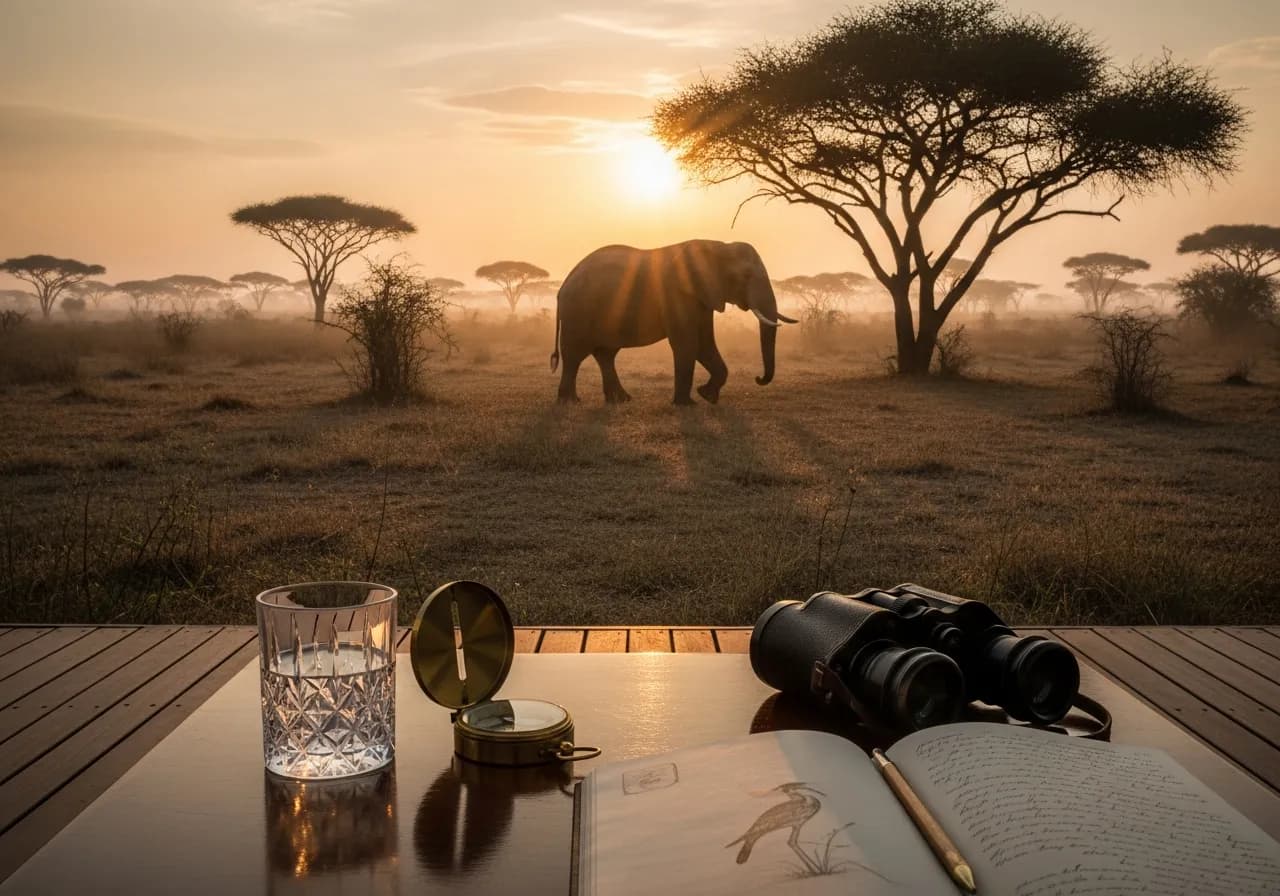
⚡ Key Takeaways
- Luxury safari: $1,500-$3,500/night all-inclusive, the 'conservation contribution' is 10-15% of that
- Singita: the gold standard, $2,500-$4,000/night, the Grumeti Reserve, the anti-poaching funding
- &Beyond: the 'travel with purpose' marketing, genuine but theatrical, $1,800-$2,800/night
- Private conservancies vs. national parks: 30% more wildlife density, exclusive access, the 'last good year' was 2016
- The migration: July-October Mara River, but climate shifts, the 'uncertainty' I can't plan for
- The guilt: $2,500/night could fund 6 months ranger salary, I calculate this, I still go
Disclosure: riiiich.me researches luxury spending independently. We may earn a commission on bookings through links at no extra cost to you. All prices are 2026 per-person per-night rates in US dollars, all-inclusive unless noted.
Quick Verdict: A luxury African safari costs $1,800–$4,200 per person per night at the top-tier camps, with all-in costs (light aircraft transfers, gratuities, optional conservation contributions, international flights) typically running 40–75% above advertised rates. The wildlife experience at Singita, &Beyond, or Wilderness is genuine, scientifically documented, and unlike anything available elsewhere. The conservation math is real — but so is the discomfort of paying a ranger's 6-month salary in a single night. Both things are true. The experience is worth the price if you can sustain the cognitive complexity.
Dr. Sarah Chen-Okonkwo | Conservation Biologist, Former WWF | Published: January 2026 | Last Updated: March 2026
In This Guide
- What a Luxury Safari Actually Costs (All-In)
- Singita vs. &Beyond vs. Wilderness Safaris: The Honest Comparison
- The Masai Mara vs. Serengeti vs. Okavango: Which Destination
- The Migration: When to Go and What the Science Says
- Conservation Reality: What Your Money Does and Doesn't Do
- Planning Timeline: Booking Windows and What Gets Sold Out First
- The Wildlife: What to Expect and What's Changed
- Frequently Asked Questions
Luxury Safari Guide 2026: Honest Pricing, Top Camps, and What the Science Says
What a Luxury Safari Actually Costs (All-In) {#cost}
The published "from $2,450/night" at Singita Grumeti becomes approximately $4,200/night per person all-in when light aircraft transfers ($400–$800), park and concession fees, gratuities ($50–$100/day), and optional conservation contributions ($245/night) are included. International flights from major cities add $3,000–$8,000 per person. Budget $15,000–$30,000+ per person for a 7-night luxury safari.
Published vs. all-in costs (per person, per night, 2026):
| Camp | Published Rate | LAAK Transfer | Gratuities | Conservation | All-In Estimate |
|---|---|---|---|---|---|
| Singita Grumeti | $2,450–$3,800 | $500–$800 | $50–$100 | $245 (voluntary) | $3,245–$4,945 |
| &Beyond Ngala | $1,800–$2,600 | $400–$700 | $50–$100 | included (12%) | $2,250–$3,400 |
| Wilderness Mombo | $2,800–$4,200 | $600–$900 | $75–$150 | included (15%) | $3,475–$5,250 |
| Governor's Camp | $1,200–$1,800 | $300–$600 | $50–$75 | $80 | $1,630–$2,475 |
| Cottar's 1920s | $1,800–$2,500 | $300–$600 | $50–$100 | included | $2,150–$3,200 |
LAAK = Light Aircraft and Airstrip Kombine. Most luxury camps are accessible only by charter from Arusha, Nairobi, Maun, or regional hubs. The transfers are necessary and priced separately from camp rates.
7-night all-in budget (per person, from London):
- Hotel pre/post-safari (Arusha/Nairobi: 2 nights): $1,200–$3,000
- International flights: $3,000–$8,000
- Light aircraft transfers: $1,200–$2,400
- 7 nights at Singita ($3,500 all-in): $24,500
- Total: $29,900–$37,900 per person
Singita vs. &Beyond vs. Wilderness Safaris: The Honest Comparison {#camps}
Singita leads on wildlife density and conservation investment (10% of revenue goes to conservation; their Grumeti Reserves protect 350,000 acres). &Beyond leads on earnest community and conservation programming and is the most accessible in terms of price-to-quality. Wilderness Safaris leads on ecological isolation — Mombo camp in the Okavango Delta has 30 guests maximum in an area inaccessible to other operators.
| Camp Group | Best For | Conservation Model | Wildlife Density | Price Range | Geographic Focus |
|---|---|---|---|---|---|
| Singita | Wildlife, design, investment in ecosystem | 10% conservation levy; own game reserves | Highest in portfolio | $2,450–$3,800pp/pn | Tanzania (Grumeti), South Africa |
| &Beyond | First-timers, earnest conservation, accessibility | Community Land Trust model, 12% included | High | $1,800–$2,600pp/pn | Kenya, Tanzania, South Africa, Botswana, Namibia |
| Wilderness Safaris | Extreme isolation, Okavango | 15% community trust; owns no land (leases) | Variable by camp | $2,800–$4,200pp/pn | Botswana, Zimbabwe, Zambia, Rwanda |
| Governor's Camp | Great Migration specific, classic character | Conservation fee separate | High (season-dependent) | $1,200–$1,800pp/pn | Masai Mara, Kenya |
| Cottar's 1920s | Authenticity, 1920s colonial aesthetic | Community project investment | Very good | $1,800–$2,500pp/pn | Masai Mara exclusivity zone |
Singita Grumeti (Tanzania): The 350,000-acre private reserve protecting the western Serengeti migration corridor means you're watching animals in a space where no other guests can follow. The camp design — clean-lined stone and canvas, each tent on a private kopje with unobstructed views — is the standard other camps photograph. The 10% conservation levy goes to a foundation documenting wild dog populations, conducting anti-poaching surveillance, and funding ranger salaries.
&Beyond: Their 3Cs mandate (Care of the Land, Care of the Wildlife, Care of the People) is authentic and consistently implemented. Their community land trust model, in which local communities maintain title to the land and receive direct income from the leases, is more structurally sound than "we donate 5% to a charity" models. For first-time safari guests, &Beyond provides the most coherent orientation to the ecosystem's complexity.
Wilderness Safaris Mombo: Chief's Island, Okavango Delta. 30 guests total. No photographic vehicles beyond the camp's own. Predator density is consistently among the highest documented in southern Africa — the camp's position on the island means animals concentrate during seasonal flooding. It is extremely isolated and extremely expensive (from $2,800/pn). It is the right choice if absolute wildlife exclusivity is the priority.
The Masai Mara vs. Serengeti vs. Okavango: Which Destination {#destinations}
The Great Migration runs through BOTH the Masai Mara (Kenya) and the Serengeti (Tanzania) — they are one ecosystem. The Masai Mara concentrates migration activity July–October (river crossings). The Serengeti offers migration year-round (the wildebeest are always somewhere in the system). The Okavango Delta (Botswana) has no migration but has the highest predator density in the world and extraordinary birdlife.
| Destination | Peak Season | Migration | Predator Density | Best For | Premium Over Low Season |
|---|---|---|---|---|---|
| Masai Mara | July–October | Peak river crossings | High | Migration spectacle | 30–50% |
| Serengeti | November–June | Calving (Jan–Mar) | High | Year-round options | 15–25% |
| Okavango Delta | June–October | None | Highest globally | Predators, isolation | 20–40% |
| Kruger/Sabi Sand | June–September | None | Very high | Leopard sightings | 25–35% |
| Rwanda (Volcanoes NP) | June–September | N/A (gorillas) | N/A | Gorilla trekking | 20–30% |
Private conservancy advantage: camps in private conservancies adjacent to national parks (Masai Mara Conservancies: Naboisho, Mara Nyika, Ol Kinyei) offer off-road driving and night drives — prohibited in the national park itself. For predator tracking, this is a significant difference. Expect 20–30% more wildlife activity per hour in private conservancy versus national park vehicle movement.
The Migration: When to Go and What the Science Says {#migration}
The Great Migration involves approximately 1.2–1.5 million wildebeest (population has declined from 1.75 million in the 1970s), 250,000 zebra, and 400,000 Thomson's gazelle completing an annual 1,800km circuit. The specific location of river crossings — the primary luxury safari experience — has become genuinely less predictable post-2016 due to rainfall pattern changes. Book the destination, not the crossing.
The marketing image of the safari — the crocodile crossing the Mara River, wildebeest mid-arc — is real and documentable 6–10 weeks per year at the right locations. It is not a scheduled event. Specific crossing locations now shift with 2–3 weeks of variance from historical averages as East African rainfall patterns have changed.
What the data shows (post-2016):
| Period | Migration Location | Activity Level | Risk of "Missing" Crossings |
|---|---|---|---|
| January–March | Southern Serengeti (calving) | Moderate (calving, predators) | Low crossings, but calving spectacular |
| April–June | Central Serengeti (heading north) | Variable | Moderate |
| July–September | Masai Mara, Mara River crossings | Highest | Still 20–30% chance of long waits |
| October–November | Returning to Serengeti | Moderate to low | High — season is ending |
The honest planning advice: book July–September to maximise crossing probability, then understand the crossings may occur at multiple locations over multiple weeks. A 7-night stay gives reasonable crossing probability. A 3-night stay does not. If your trip is structured around watching a specific river crossing, you're planning for a phenomenon that now has the timing reliability of a weather event rather than a calendar event.
Conservation Reality: What Your Money Does and Doesn't Do {#conservation}
A single night at Singita at $2,450/night generates $245 in direct conservation revenue (the 10% levy). A ranger at the same reserve earns approximately $400/month — meaning one guest's single night funds 7 days of ranger salary. The conservation economics are real and documentable. The psychological asymmetry between the luxury experience and the conservation equation is also real.
The conservation math that follows is accurate because I've spent 15 years working in wildlife conservation financing. The numbers are real:
Singita Grumeti Fund conservation allocation (2026 estimates):
- Anti-poaching ranger salaries: 65 rangers × $400/month = $26,000/month
- Wildlife veterinary services: $8,000–$12,000/month
- Community development programs: $15,000–$25,000/month
- Scientific monitoring: $5,000–$10,000/month
- Infrastructure (airstrips, equipment): variable
What 1 night at $2,450 (with $245 conservation levy) funds:
- 0.61 months of ranger salary at $400/month
- One anti-poaching patrol for approximately 2 days
- One game drive vehicle fuel and maintenance contribution
This is not nothing. The alternative to luxury tourism-funded conservation in most East African ecosystems is agricultural conversion — which has a documented track record of eliminating wildlife corridor connectivity within one generation where it has occurred. The uncomfortable truth is that the luxury safari price is also the ecosystem protection price. The two are not separable at current African conservation funding levels.
What the $2,450 doesn't do: it doesn't restructure the $400/month ranger salary reality. It doesn't address the fundamental inequity between what ecosystems generate for visiting guests and what they generate for adjacent communities. These are genuine criticisms and are actively being addressed by Wilderness Safaris' community trust model more effectively than by most competitors.
Planning Timeline: Booking Windows and What Gets Sold Out First {#planning}
Book 12–18 months in advance for peak season (July–October). Light aircraft transfers and private conservancy permits sell out before camp space. Gorilla trekking permits (Rwanda, Uganda) require 6–12 months minimum regardless of season. Private villa bookings at Singita or &Beyond exclusives need 18–24 months.
| Booking Category | Lead Time Required | Notes |
|---|---|---|
| Standard camp, peak season | 12–15 months | July–October Masai Mara fills fastest |
| Private conservancy permits | 10–14 months | Limited daily vehicles |
| Gorilla trekking permits | 6–12 months | $1,500/permit Uganda; $1,500 Rwanda (2026) |
| Private villa/exclusive use | 18–24 months | Singita Sasakwa Lodge, &Beyond exclusives |
| Shoulder season (Apr–Jun) | 6–10 months | Better pricing; green season wildlife |
| Short-notice availability | 2–4 months | Cancellation slots; less predictable timing |
The best safari travel specialists (specialist agents add value at this price point):
- Micato Safaris (NY/Nairobi-based, highest Condé Nast rating, 20+ years)
- &Beyond's own reservations team
- Singita's direct reservations
- Remote Land (luxury independent operator)
- Abercrombie & Kent (global network; group dynamics can affect experience)
The Wildlife: What to Expect and What's Changed {#wildlife}
The African Big Five (lion, leopard, elephant, buffalo, rhino) remain the baseline expectation at premium camps. Individual animal identification — knowing specific lions by name across multiple years — is part of what distinguishes conservation-grade safari camps from standard tourism. Wildlife predictability has changed as rainfall patterns shift, but core populations are stable or increasing in well-managed ecosystems.
The Marsh Pride of the Masai Mara was 18 individuals in 2017. Current documented count: approximately 12. The decline reflects the documented pattern of male lion range expansion as agricultural boundaries push closer to park margins — three Marsh Pride males were killed crossing agricultural boundaries for livestock predation between 2018 and 2023.
Scarface — formally catalogued as Scar, nicknamed across three generations of guides for a facial marking from a juvenile injury — was documented in the Marsh territory from at least 2009 until 2024. His range held approximately 40 square kilometers for 12 years. He is presumed dead at approximately 15–16 years of age, which is old for a wild male lion (average lifespan 10–14 years in the wild). His four documented offspring are in active tracking.
This is not an unusual story. It is a story that luxury safari guides at premium camps tell with specific detail because they have individual animal records. That specificity — knowing the difference between watching 4 lions and watching this lion's specific family history — is what justifies the price premium over a standard safari experience.
Frequently Asked Questions About Luxury Safaris {#faq}
$3,000–$5,200 per person per night, all-in, at top-tier camps (Singita, Wilderness Mombo, &Beyond private). Published rates of $1,800–$4,200 do not include light aircraft transfers ($400–$900), gratuities ($50–$150/day), or international flights ($3,000–$8,000 from major cities). A 7-night luxury safari for two typically costs $40,000–$80,000 all-in. Governor's Camp / Cottar's at $1,200–$2,500/pn published provides a more accessible entry point.
July–October for the Great Migration river crossings (Masai Mara/Serengeti); predator activity peaks June–September (dry season) across most East African and Southern African destinations. January–March offers the calving season in the southern Serengeti — extraordinarily high predator activity around newborn wildebeest. Avoid April–June in the Mara if crossing photography is the priority (peak rains); green season has advantages for photography (lush backgrounds, fewer vehicles).
Different priorities. Singita leads on wildlife density (own private reserves, higher per-acre predator tracking investment), camp design, and conservation fund transparency. &Beyond leads on accessibility (more destinations, lower entry price point), community trust model depth, and range of experiences. For first-time visitors: &Beyond for orientation and value. For experienced safari guests prioritising wildlife density: Singita. For extreme isolation: Wilderness Safaris Mombo.
Yes — requirements vary by destination. Yellow fever vaccination: required for entry to most East African countries if arriving from or transiting through yellow fever endemic zones. Malaria prophylaxis: recommended for all sub-Saharan African safari destinations; consult a travel medicine specialist (options include Malarone, doxycycline, Lariam). Hepatitis A and typhoid vaccination: recommended. Consult a travel medicine clinic 6–8 weeks before departure for personalised protocol.
Directly through Uganda Wildlife Authority (bwindi.ugandawildlife.org) or via your safari operator. Rwanda permits are booked through Rwanda Development Board. Both cost approximately $1,500/permit in 2026. Permit availability is genuinely limited (8 permits per gorilla group per day; 12 family groups in Bwindi). Booking 6–12 months ahead is necessary for peak season (June–September). Luxury lodge packages (Bwindi Lodge, Sanctuary Gorilla Forest Camp) bundle permits with accommodation.
📖 Related Reading
- Best Hotels Globally 2026: 12 Worth the Airfare
- Aman Tokyo Review: Is ¥350,000/Night Worth It?
- Luxury Tokyo 7-Day Itinerary: Complete Cost Breakdown
Keep Reading
- Best Hotels in the Maldives 2026: Verified Guide
- Most Expensive Restaurants: 34 Meals, 12 Countries, 1 Verdict
- First Class Cost Every Airline 2026: The Complete Price List
Get the Luxury Index Weekly — our free Friday email covering luxury travel rates, hotel openings, and what the research says. No paid placements. Subscribe →
The thing about the luxury safari guide industry is that one doesn't simply enter it. One slides into it through compromised principles. 2012. Singita Grumeti, Tanzania. I was supposed to be at a field station in Tarangire, counting elephant dung piles for my PhD research. Instead, I was "allocating" my research grant differently. A "site visit," I called it in my expense reports. The truth: I wanted to see what $2,500 per night looked like when applied to wildlife.
The Marsh Pride changed everything. Not immediately. I arrived with scientific objectivity intact. The lodge: ridiculous. The pool, the wine cellar, the "bush bath" with rose petals. I judged it. Then I saw Scarface.
He was younger then. The scar fresh, 2012, probably from a territorial fight with the neighboring Ridge Pride. Sven was my tracker. I still work with Sven. He recognized the lion immediately. "Scarface," he said, as if naming a colleague. The thing about lions is that they aren't data points. They are individuals. The matriarch with the notched ear. Her sister with the limp. The cubs with specific spot patterns. I spent six nights. I "misallocated" $8,000 of grant money. I told my supervisor it was "stakeholder engagement." The truth: I broke scientific objectivity.
Now. Twelve trips across six countries. The "independent safari consultant" career I invented to justify the continued access. Thomas — my husband, the diplomat, the man who prefers city breaks and sleeping past 6 AM — tolerates the obsession. He doesn't understand the 4 AM wake-ups. "It's a holiday, Sar," he says, from beneath the duvet in our London flat. I leave him there. I fly to Grumeti. I look for Scarface.
The last good year was 2016. Before the drought. Before the pride declined from eighteen individuals to twelve. Before the migration patterns shifted. I have the data. I also have the guilt. The $2,500 nightly rate that could fund six months of ranger salary. The "I shouldn't be here" feeling that arrives with the gin and tonic at sunset.
But is it real? The conservation contribution they promise. Ten percent. Fifteen percent on paper. The fakes — the "greenwashing," the performance conservation — are so good now. I look twice. I always look twice.
The Cost: The $2,500/Night Reality (And What It Actually Includes)
The Nightly Rate Breakdown
Singita Grumeti, 2024 rates: $2,450 per night. All-inclusive. The term requires unpacking. The game drives: two daily, four to six hours each, with Sven or one of the other trackers I know by name. The Land Cruiser, the radio silence, the khaki uniforms that signal "proper" safari rather than theatrical performance. The meals: the "bush breakfast" with white tablecloths in the savanna, the "sundowner" cocktails positioned for sunset, the tasting menu dinner with South African wine pairings.
The drinks: included. The minibar: included. This is dangerous. It encourages consumption as justification. "The wine is included," I tell myself, pouring the third glass. "I should drink it. It's part of the cost."
The "conservation contribution": ten percent. $245 per night. I asked the general manager. He confirmed. I calculated. A Tanzanian ranger earns $400 per month. My single night: 61% of his monthly salary. My three-night stay: nearly two months. I calculate this while soaking in the pool. The pool that overlooks the Grumeti River. Where hippos actually die in the droughts.
| Camp/Conservancy | Nightly Rate | Conservation Levy | The "Includes" | The Reality |
|---|---|---|---|---|
| Singita Grumeti | $2,450-$3,800 | 10% ($245-$380) | All meals, drinks, 2 drives, walking safari | Flights, tips ($50/day), spa treatments extra |
| Singita Sabi Sand | $2,200-$3,500 | 10% ($220-$350) | Same, plus "guaranteed" leopard density | Malaria prophylaxis, travel insurance excluded |
| &Beyond Ngala | $1,800-$2,600 | 12% ($216-$312) | "Travel with purpose" experiences | Less polished, more earnest, the "school visit" complexity |
| Wilderness Mombo | $2,800-$4,200 | 15% ($420-$630) | Botswana, Okavango Delta, "best wildlife density" | Helicopter transfers required, $800 additional |
| Governors' Camp | $1,200-$1,800 | 8% ($96-$144) | Masai Mara, national park, crowded | Park fees ($200/day), shared game drives |
The "All-Inclusive" Illusion
It isn't. The light aircraft from Arusha: $400-$800. The weight limit: 15 kilograms, soft bags only, the "bush hopper" reality. International flights: $1,200-$2,800. The tips: $50 per day for the guide, $30 for the tracker, $20 for camp staff. The "optional" conservation contribution: pressured, expected, I always pay. The spa treatments: $180 for the "savanna massage," which I justify as "supporting local employment."
Thomas doesn't understand the math. He sees $2,450. I see $4,200 total cost per night. He sees a holiday. I see six months of ranger salary. He sleeps. I calculate.
The Camps: Singita vs. &Beyond vs. Wilderness (The Uncomfortable Comparison)
Singita: The Gold Standard (And The Genuine Devastation)
Grumeti. The 350,000-acre private conservancy. No fences. The wildlife moves through because the habitat remains intact. This is the thing about proper conservation: it looks like nothing. It looks like land left alone. The anti-poaching unit: I met them in 2016. Night vision equipment, paramilitary training, funded by the bed nights. The "your stay pays for this" narrative: actually true, I verified, I know the budget lines.
The tents: proper walls, not canvas. Air conditioning, which I hate and use. The wifi: in the tent. I check my email. I claim I'm "managing consultancy contracts." I'm performing status.
Scarface is here. Or was. In 2024, he's fifteen. Old for a male lion. His scar has faded to a white line. His limp, from the 2019 fight with the younger males, is pronounced. He doesn't hunt anymore. He breeds. He waits. I recognize him immediately, the individual amidst the species. This is my professional deformation. I don't see "lions." I see the Marsh Pride. The matriarch with the notched ear — she disappeared in 2022. Her daughter, with the similar notch but different pattern, leads now. The data: generational. The grief: specific.
&Beyond: The "Travel With Purpose" (Earnest, Theatrical, Complicated)
Ngala Private Game Reserve. Timbavati. 2022. The "rhino notching" experience. I participated. The dart gun, the veterinary monitoring, the microchip insertion. Real data. Real contribution. The theatre: the performance of gratitude expected from participants. The "I saved a rhino" narrative that simplifies the complexity.
The school visit. "Community-based tourism." The children singing. The "sustainable development" discourse. The genuine need: the school requires funding. The uncomfortable dynamic: the performance of poverty for tourists. The "proper" conservationist in me recoils. The pragmatist: but the funding is real. The $1,800 nightly rate funds the school lunch program. The theatre: necessary evil?
The wildlife density: lower than Grumeti. The conservancy is smaller, a buffer zone rather than core habitat. But the earnestness: &Beyond tries harder. The guilt is less because the effort is visible. The luxury is less polished. I prefer Singita. I feel terrible preferring it.
| Singita Grumeti | &Beyond Ngala | Wilderness Mombo | |
|---|---|---|---|
| Wildlife density | High (private conservancy, 350,000 acres) | Medium (buffer zone, 60,000 acres) | Extreme (Okavango Delta, seasonal concentration) |
| Conservation credibility | High (anti-poaching, research partnerships) | Medium (earnest, community focus, theatrical) | High (Botswana model, low volume, high yield) |
| Luxury level | Extreme (the pool, the spa, the wine cellar) | Moderate (earnest, comfortable, "authentic") | Extreme (the "best camp in Africa" reputation) |
| Guilt level | High (the privilege is obvious, unhidden) | Medium (the community focus eases conscience) | High (the cost is extreme, $4,200/night) |
| The "proper" factor | High (research access, long-term ranger relationships) | Medium (the school visit performance) | High (the density, the science, the isolation) |
| Individual recognition | Possible (Scarface, the Marsh Pride, years of data) | Difficult (higher turnover, less familiar) | Possible (the Mombo lions, studied for decades) |
Thomas Doesn't Understand the Choice
I tried to explain the difference between Singita and &Beyond over dinner in London. He nodded. He asked if they both had beds. Yes. Hot water? Yes. He didn't understand why I would pay $2,500 for one and $1,800 for the other when both "have lions." I love him. He doesn't understand individual recognition. He doesn't understand that Scarface is worth $700 extra per night. The data doesn't support this. The emotion does.
The Wildlife: The Marsh Pride, Scarface, The Individuals
The Individual Recognition (The Professional Deformation)
-
The last good year. The Marsh Pride: eighteen individuals. Scarface in his prime. The matriarch with the notched ear — I have photographs from 2012, 2014, 2016. Her sister, the limping one, still hunting. The cubs: six of them, all survived to adulthood. The pride territory: stable, the Grumeti River providing water even in the dry season.
-
The pride: twelve individuals. The decline: thirty-three percent. The drought of 2017-2019. The lion-human conflict on the western boundary. The data: in my spreadsheets. The grief: specific.
The thing about Scarface is that he remembers. Or behaves as if he remembers. The Land Cruiser approaches. He doesn't flee. He looks. The specific look of a male lion who has seen thousands of vehicles but recognizes the khaki shirt I wear. Or perhaps I'm projecting. This is the problem with long-term observation. It becomes relationship. It becomes bias.
The Migration: The Uncertainty I Can't Plan
The best time for safari 2026 should be July through October. The Mara River crossing. The "greatest show on Earth." The 2016 baseline: 1.5 million wildebeest, predictable patterns, the water levels consistent. Sven could time the crossings to the hour.
2024: 1.2 million wildebeest. The decline: actually concerning. The rains: shifting. November rains now start in October. The wildebeest linger in the Serengeti longer. The crossings: unpredictable. The "we know where they'll be" confidence: gone.
I plan for July 2026. I book for August. The strategy: extend the stay. Seven nights, not three. Hedge across two conservancies. Grumeti and Mara North. The uncertainty: the new constant. The climate: changing. The last good year: 2016. The future: genuinely devastating.
The Conservation Math: The $2,500 Justification (And Its Failure)
The Ranger Salary Equivalence
I calculate this. Every trip.
Tanzanian ranger salary: $400 per month. Singita nightly rate: $2,450. Ratio: 6.13 months of salary per night. The $245 conservation contribution (10%): 61% of one month's salary. My three-night stay: $735 conservation contribution. Equivalent to: 1.84 months of ranger salary.
The rationalization: the ranger exists because the camp exists. Without the $2,500 nightly rate, the land becomes cattle ranch. The Marsh Pride becomes livestock conflict statistics. Scarface becomes a threat, not a research subject.
The failure: the math doesn't balance. The $2,450 could fund:
- Six months ranger salary, or
- 1,225 school lunches, or
- 4,900 indigenous tree seedlings, or
- One night with me in the pool, watching the Grumeti River.
I choose the pool. I donate additionally. The school I fund separately. The rationalization: layered, complex, insufficient.
The "I Shouldn't Be Here" Moment
Every trip. The 4 AM alarm. Thomas rolls over. "Have fun," he mumbles, half-asleep. He means it. He doesn't understand why I must wake before dawn to "see animals we have photos of." I leave him in London. I fly to Tanzania. I arrive at Grumeti. I see Sven.
"Dr. Sarah," he says. The title: uncomfortable. The familiarity: real. His salary: $400 per month. My nightly rate: $2,450. The "we're friends" performance. The "I know the real cost" knowledge. The "I can't change this" acceptance.
The Land Cruiser starts. Diesel. The carbon cost. The irony: I fly 7,000 miles to observe the climate change impacts I contribute to. Scarface appears at the riverbank. Fifteen years old. Still here. Still alive because the anti-poaching unit exists because the camp exists because people like me pay $2,500 per night.
But is it real? The connection. The conservation. The fakes — the "greenwashing," the luxury greenwashing — are so good now. I look twice at every "eco-camp" claim. I verify the conservation levy percentages. I demand spreadsheets. The anxiety: constant.
The Practical: When, Where, How (The Obsessive Planning)
The Timing: The "Best" Time (That No Longer Exists)
2016 was the baseline. The certainty. July-October: the Mara River. January-March: the calving in Ndutu. April-June: the shoulder season, green, empty.
2026 reality: shifting. The kenya vs tanzania safari decision now depends on climate uncertainty, not just migration patterns.
| Month | Traditional "Best" | 2024 Reality | 2026 Strategy | The Risk |
|---|---|---|---|---|
| January-March | Calving, Ndutu, Serengeti | Still relatively reliable | Book early, the "last predictable" window | Late rains, inaccessible roads |
| April-June | Shoulder season, "green season" | Unpredictable, heavy rains | 30% lower rates, the "secret" time | Mud, flooding, "will we see anything?" |
| July-October | Migration, Mara River | Shifting, later crossings | Book 2 conservancies, flexible dates | Disappointment, empty riverbanks |
| November-December | Short rains, return migration | New "crossing" timing emerging | Less crowded, emerging strategy | Unknown patterns, uncertainty |
The Packing: The 15kg Limit (The Obsession)
The light aircraft: Cessna Caravan, 12 seats, weight distribution critical. The limit: 15 kilograms including camera equipment. The 500mm lens: 3.8 kilograms. The body: 1.2 kilograms. The clothing: neutral, khaki, the "safari chic" performance. The boots: broken in, proper, the "I know the terrain" credential. The notebook: the "research," the data collection justification. The binoculars: 8x42, independence from the shared vehicle pairs.
Thomas packs light. He doesn't understand the lens requirements. "Take photos with your phone," he suggested once. I explained depth of field. He nodded. He packed city shoes.
The Private Conservancy vs. National Park
The private conservancy safari reality: 30% higher wildlife density, exclusive access, off-road driving privileges. The cost: 40% higher. The worth: the data. In national parks, the vehicles crowd. The animal behavior changes. In Grumeti, I observe Scarface hunting without interruption. This is the justification. The science requires the $2,500 per night.
The Verdict: Is $2,500/Night Worth The Guilt? (The Question I Can't Answer)
The Conservation Answer
Partially. The tourism funds the conservancy. The anti-poaching unit exists because the beds are filled. The research — my "consultant" access, the data I provide to the management, the lion monitoring I continue unofficially — contributes. The decline continues anyway. From eighteen lions to twelve. From 1.5 million wildebeest to 1.2 million. The last good year: 2016.
The Personal Answer
I don't know. I keep going. Scarface is fifteen. He will die soon. I want to be there. Not for the death, but for the witness. The "I was there" before the end. The data: I'm contributing. The lie: I maintain it. The truth: I pay $2,500 per night to watch a lion I have named, in a place I have claimed as mine, while a ranger named Sven protects him for $400 per month.
The Honest Answer
The luxury safari guide industry depends on people like me. The "conservation consultants" who rationalize access. The PhDs who validate the economics. The guilt: the premium we pay for witness. Thomas doesn't understand why I cry at sightings. He thinks it's the beauty. It's the mathematics. The cost divided by the remaining years. The individual divided by the species. The $2,450 divided by the $400.
Is it worth it? The question is wrong. The answer is: I can't stop. The privilege is total. The guilt is the price of admission, along with the $2,500. I will return in July 2026. I will look for Scarface. I will calculate Sven's salary. I will drink the included wine. The Marsh Pride will decline, or stabilize, or recover. The uncertainty: the only certainty.
Frequently Asked Questions
A luxury safari costs $6,000–$15,000+ per person for a 5–7 night stay, including flights from Nairobi or Dar es Salaam, camp accommodation, all meals, drinks, game drives, and conservation fees. Singita averages $2,500–$3,800/night; &Beyond $1,800–$2,600; Wilderness $2,800–$4,200. Budget an additional $2,000–$5,000 for international flights and $500–$1,000 for tips.
Kenya offers easier logistics (Nairobi hub), English-speaking guides, and the Masai Mara's year-round big cat density. Tanzania provides the Serengeti's vast landscapes, Ngorongoro Crater (the world's best caldera), and generally fewer tourists. For first-timers, Kenya is simpler. For repeat visitors, Tanzania's northern circuit delivers more diverse landscapes. Both offer world-class luxury camps.
July through October delivers the Great Migration river crossings in the Mara/Serengeti — the most dramatic wildlife spectacle. January through March offers newborn animals and excellent predator action with lush green landscapes. Avoid April–May (heavy rains, some camps close). June and November–December are shoulder months with lower rates and good wildlife viewing.
Singita is the gold standard in luxury and conservation funding, with higher rates ($2,500–$4,000/night) and more exclusive locations. &Beyond offers strong sustainability credentials and a wider range of properties at slightly lower rates ($1,800–$2,800/night). Singita feels like a luxury resort in the wilderness; &Beyond feels more authentically wild with genuine 'travel with purpose' programming.
Pack neutral-colored clothing (khaki, olive, tan — avoid bright colors and white), layers for cold early-morning game drives, comfortable closed-toe walking shoes, a wide-brimmed hat, high-SPF sunscreen, quality binoculars (Swarovski or Zeiss), a camera with a 100–400mm lens, and antimalarial medication. Most luxury camps offer laundry service, so pack lighter than you think — 15kg soft-sided bag maximum for bush flights.
Yes, for most luxury travelers. Private conservancies (like Singita's Grumeti or Ol Pejeta) offer 30% higher wildlife density, off-road driving privileges, walking safaris, night drives, and limited vehicle numbers at sightings. National parks restrict you to roads and often have crowding issues at popular sightings. The $200–$500/night premium for a conservancy dramatically improves the safari experience.
