⚡ Key Takeaways
- Dubai scored 8.8/10—best concentration of luxury hotels on earth, world-class dining, flawless city infrastructure
- $214,000 across 16 trips: Hotels $89,400 · Flights $47,200 · Dining $38,600 · Shopping $28,300
- Visit November–March only—June–September outdoor experience is effectively eliminated by heat
- Hotels 9.5/10 and Safety 9.5/10; Culture & History 6.5/10 is the weakest category
- Worth visiting for hotel collectors, foodies, couples, and families; not for history pilgrims or nature purists
⚡ Quick Verdict: Dubai is worth visiting if you want the world's best hotels, genuinely excellent dining, and a skyline that makes your cynicism feel embarrassing. It is not worth visiting if you need ancient history, temperate weather, or a city that apologizes for being expensive. I've been 16 times. I've spent $214,000. I'm going back in November. Take from that what you will.
Trip One: The Skeptic Arrives
I landed in Dubai for the first time in December 2016 with the ironclad certainty that I would hate it.
I was 34, aggressively British, and had spent the previous decade cultivating a personality built on dismissing places that lacked "authenticity"—a word I deployed with the confidence of someone who'd read three Paul Theroux books and mistaken them for a worldview. Dubai, I'd decided before ever setting foot there, was a shopping mall with a passport. A theme park for people who confused spending with taste. A monument to late capitalism's most garish impulses, built on sand and audacity and nothing I needed to experience.
I was transiting to the Maldives. The layover was 19 hours. My plan was to sleep at an airport hotel, eat something forgettable, and board my connection with my prejudices perfectly intact.
Instead, a colleague who lived in Dubai insisted—insisted—on collecting me, driving me Downtown, and standing me in front of the Burj Khalifa at sunset. I remember the moment with uncomfortable precision. The fountain erupted. The light caught the tower. A thousand strangers from thirty countries stood together in genuine, unironic awe. And I felt—beneath several protective layers of English snobbery—something shift.
I didn't love Dubai that night. But I stopped being sure I'd hate it.
That uncertainty cost me $214,000 over the next eight years.
The $214,000 Accounting
Transparency matters more than comfort, so here's where the money went across 16 trips:
| Category | Total Spent | Notes |
|---|---|---|
| Hotels | $89,400 | 87 nights across 14 properties, from $510/night to $2,500/night |
| Flights | $47,200 | 11 flights in First Class, 5 in Business |
| Dining | $38,600 | 47 restaurants ranked, 23 brunches survived |
| Shopping | $28,300 | Two watches, one regret, several bags |
| Rooftop Bars | $6,100 | 19 rooftop bars, 73 cocktails, 1 lost phone |
| Everything Else | $4,400 | Taxis, tips, desert safaris, one spa treatment that made me cry |
| Total | $214,000 | Over 8 years. Which is $26,750/year. Which is... fine. It's fine. |
My accountant describes this spending pattern as "consistent." My therapist describes it as "worth exploring." My wife describes it as "the reason we're not renovating the kitchen." All three are correct.
The question—is Dubai worth visiting—is really a question about value. Not price. Value. And value requires knowing what you're getting, what you're not getting, and whether the gap between the two is something you can live with.
After $214,000, I have answers.
What Dubai Gets Absolutely Right
The Hotels Are the Best Concentration on Earth
I have stayed at luxury hotels in 27 countries. I've reviewed properties from Tokyo to the Maldives, debated Four Seasons versus Ritz-Carlton as though it were a geopolitical conflict, and ranked the 50 best hotels in the world with a methodological rigor that my university dissertation did not receive.
No city matches Dubai for luxury hotel density.
Within a 25-minute drive, you can stay at: Atlantis The Royal (the $1,400/night spectacle that redefines what a resort can be), Burj Al Arab (the $2,500/night icon that somehow still justifies the price), Bulgari Resort (Italian restraint at $1,100/night), One&Only The Palm (the best couples property on Palm Jumeirah), Mandarin Oriental Jumeira (beachfront subtlety at $750/night), Four Seasons DIFC ($650/night sophistication for the business traveler), or the Armani Hotel inside the Burj Khalifa itself.
That's seven world-class hotels in one paragraph. I didn't even mention the Address Beach Resort, the best hotel suites ranging from $1,340 to $38,000 per night, or the new properties opening in 2025–2026 that will make this list longer.
The competition between these hotels is what makes them exceptional. When your nearest competitor is a fifteen-minute drive away and offers a comparable room at a lower rate, you cannot afford complacency. Dubai's hotels compete with a violence that London, Paris, and New York hotels simply don't—because in those cities, geography creates natural monopolies. In Dubai, everything is accessible to everything else, and the consumer benefits enormously.
My detailed breakdown of what $500, $1,000, and $2,500 per night actually buys you is the piece I recommend most often to first-time visitors. The range is wider than you'd expect, and the quality floor is higher.
Is the hotel scene alone worth visiting for? Honestly? For hotel people—people who choose destinations based on where they'll sleep—yes. Dubai's hotels are worth the flight.
The Food Is No Longer a Surprise—It's a Certainty
Trip one, I expected terrible food.
Trip sixteen, I actively plan which restaurants to revisit and which new openings to test. The transformation in my expectation mirrors the transformation in Dubai's dining scene: what was once a city of hotel buffets and imported steakhouses is now a legitimate global food destination.
I've ranked 47 Dubai restaurants from Tresind Studio (progressive Indian that rivals anything in London) to Ravi Restaurant (Pakistani food, $10/person, more authentic than 90% of what passes for "cultural dining" in major Western cities). Seven Dubai restaurants made my 60 best restaurants in the world ranking. For context, that exceeds Berlin, Sydney, and most cities that consider themselves "food cities."
The brunch culture is unique to Dubai and genuinely worth experiencing—a 3-4 hour, all-you-can-eat, all-you-can-drink Friday institution that costs $100-300/person and functions as the city's primary social infrastructure. I've done 23 of them. I'd do them again. My liver disagrees.
The rooftop bars add another layer—19 bars I've tested, ranging from $18 cocktails at Level 43 to $40 cocktails at Gold On 27 inside the Burj Al Arab, each offering a view that competitors in London or New York literally cannot replicate because those cities weren't designed by someone who thinks every building should be a photograph.
The most expensive restaurants exist here too—$300-500/person fine dining that's excessive and occasionally brilliant. The cheap restaurants—$8-30/person—are the secret that Dubai's own marketing fails to communicate. Both ends of the spectrum are worth visiting for.
The City Functions Like a Machine
This is the thing that surprises European and American visitors most, and it's the thing I most appreciate after 16 trips.
Dubai works.
The taxi comes when you call it. The hotel room is ready when they say it will be. The restaurant honors your 8:30 PM reservation at 8:30 PM. The metro is clean, air-conditioned, and runs on time. The roads are maintained. The Wi-Fi functions. The infrastructure is new because the city is new, and the maintenance is rigorous because the city's brand depends on things working.
Coming from London—where I've waited 40 minutes for an Uber in the rain, where the Tube closes for "improvement works" every other weekend, where hotel rooms occasionally feature carpets older than the nation of Dubai—the operational competence is not a small thing. It's not a luxury. It's the foundation upon which every other experience sits.
You cannot enjoy a $400 dinner if the taxi doesn't show. You cannot appreciate a $1,000/night hotel room if the air conditioning breaks. You cannot photograph the Burj Khalifa at sunset if the observation deck is "temporarily closed for maintenance." These failures happen in other cities. They do not happen in Dubai. The city's contract with its visitors is: come here, spend money, and everything will work. It keeps that contract with terrifying reliability.
The Safety Is Genuine
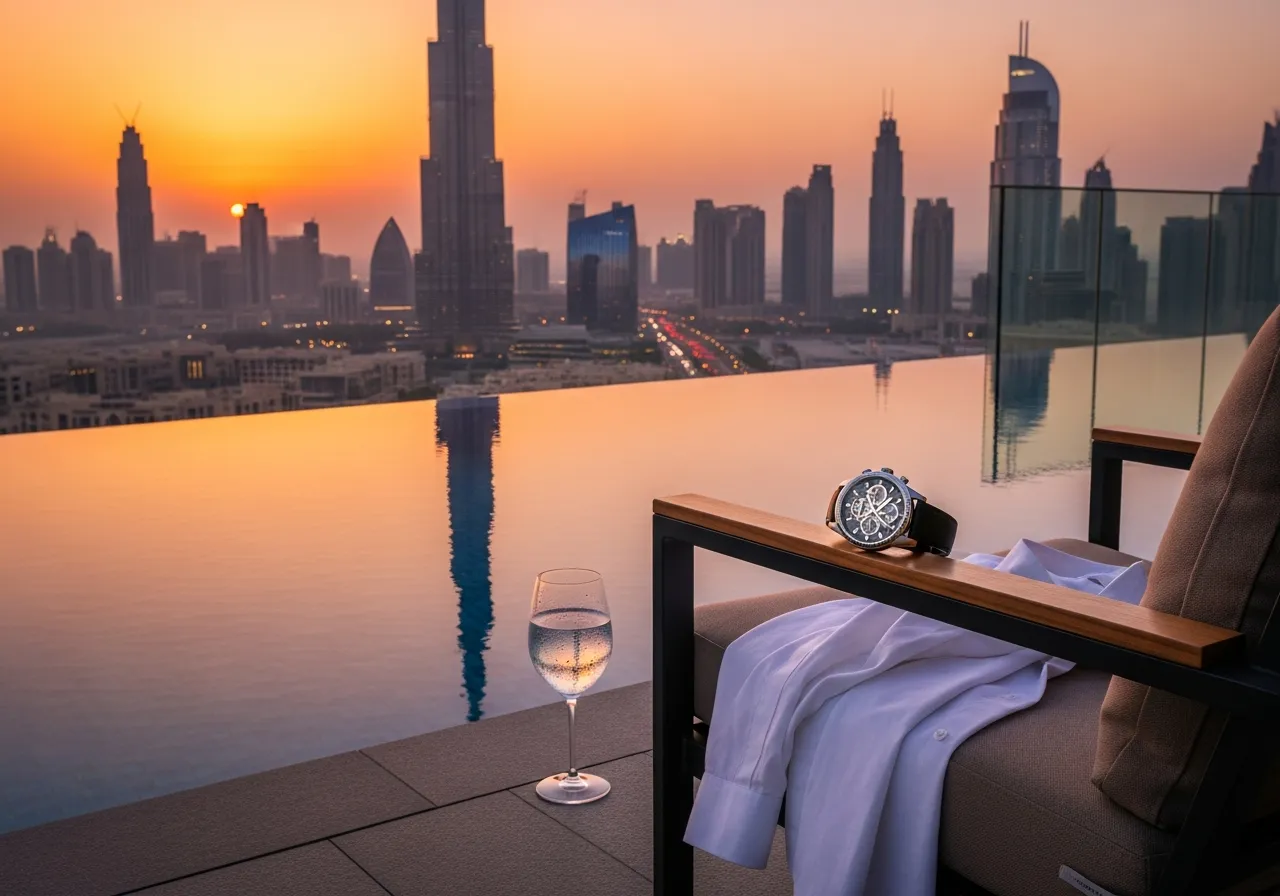
I've left a phone on a restaurant table. I've left a watch worth several thousand pounds on a hotel pool lounger. I've walked through DIFC at 2 AM after too many cocktails without a single concern beyond finding a taxi.
Dubai's crime rate for tourists is effectively zero. Not low—zero in any practical sense. Petty theft is rare. Violent crime in tourist areas is almost nonexistent. The police presence is visible but not oppressive. The result is a city where you can relax in a way that London, Paris, New York, and Barcelona cannot currently offer.
For families traveling with children, this safety factor is decisive. For couples on romantic trips, it means evenings out don't carry the ambient anxiety that accompanies nights out in other major cities. For solo travelers, it means freedom.
Safety is not exciting to write about. It's the most important thing I can tell you about the experience of being in Dubai.
What Dubai Gets Wrong (And What I've Made Peace With)
The Heat Is a Genuine Limitation
From June through September, Dubai is uninhabitable outdoors.
I'm not being dramatic. Temperatures exceed 45°C (113°F). Humidity regularly surpasses 80%. Walking from a car to a building entrance produces the kind of perspiration that makes you question whether the human body was designed to exist on this planet. The outdoor pool at your luxury beach hotel—the one you're paying $700/night to access—feels like a heated bath that someone forgot to make comfortable.
The city adapts. Everything moves indoors. Malls become social infrastructure. Hotel lobbies become living rooms. The population hibernates in reverse—sheltering from heat instead of cold, emerging in November the way Europeans emerge in April, blinking and grateful.
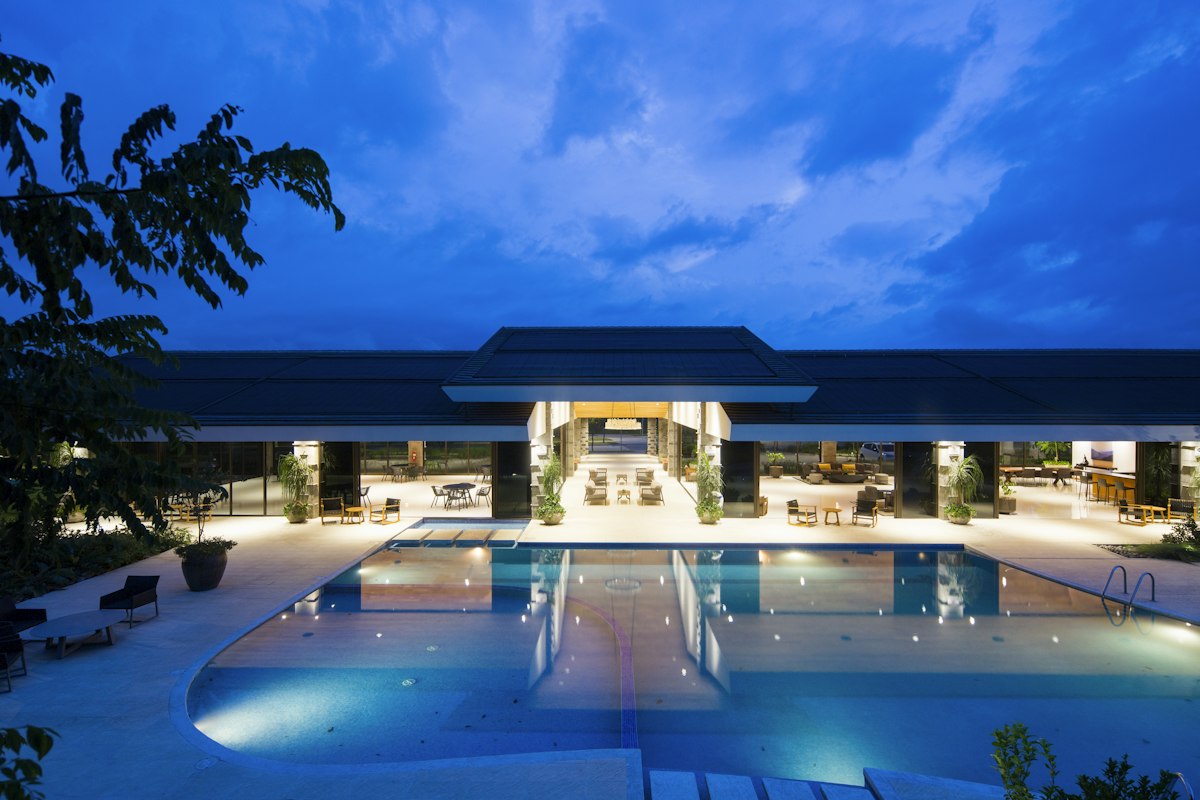
The non-negotiable advice: Visit between November and March. Peak season hotel rates are 30-60% higher, but the experience is 300% better. A bargain hotel rate in August is not a bargain—it's a discount on misery. I made this mistake on trip three (July 2018, a work obligation). I remember nothing positive about the outdoor experience. I remember the hotel was excellent. I remember not leaving it.
The Culture Is Real, But Different
"Is there anything real in Dubai?"
I've been asked this at dinner parties in London, in hotel lobbies in Paris, and by taxi drivers in Tokyo. The question contains its own assumption: that "real" means "old." That authenticity requires centuries. That a city built in 50 years cannot have a soul.
I understand the instinct. I shared it, once.
Here's what I've learned across 16 trips: Dubai's authenticity is in its ambition, not its antiquity. The city is a genuine expression of what happens when visionary leadership, impossible geography, global labor, and staggering wealth converge on a single point in the desert and decide to build something that shouldn't exist. That is real. The execution—the Burj Khalifa, the Palm, the hotels, the restaurants, the infrastructure—is the cultural artifact. You're not visiting a museum of the past. You're visiting a prototype of the future.
This doesn't satisfy everyone. Some travelers need gothic cathedrals and cobblestone streets and buildings that predate their grandparents. Valid. Go to Prague. Go to Kyoto. Go to Edinburgh. But don't mistake your preference for a universal truth.
The Old Dubai that does exist—Al Fahidi Historical District, the textile and spice souks in Deira, the dhow wharves on Dubai Creek—is worth a half-day visit. It won't compete with the medina of Marrakech or the backstreets of Rome. It will give you context for what the city was before it became what it is, and that contrast is, itself, a kind of cultural experience.
The Labor Question Deserves Honest Acknowledgment
I'm going to do what most luxury travel writers don't: address this directly.
Dubai was built by migrant workers. Millions of them—from India, Pakistan, Bangladesh, the Philippines, Nepal—working under the kafala sponsorship system that historically tied workers to specific employers. The most egregious conditions—reports of passport confiscation, wage theft, unsafe construction sites—drew international condemnation throughout the 2000s and 2010s.
The UAE has implemented reforms. The Wage Protection System now requires electronic salary payments, making wage theft harder. Midday outdoor work bans operate during summer months. Workers can now change employers without consent. The 2020s have seen measurable improvements.
"Improved" is not "resolved." And any honest assessment of Dubai must sit with the tension between the gleaming lobby of your hotel and the labor conditions that produced it. I sit with this tension every visit. I don't resolve it. I don't pretend it doesn't exist. I also don't pretend it's unique to Dubai—construction workers in Qatar, domestic workers in Hong Kong, agricultural workers in Southern Italy, and warehouse workers in America all face comparable exploitation within different systems.
What do you do with this knowledge? That's a personal decision. I've made mine. You'll make yours. I respect both choices as long as they're informed rather than reflexive.
Everything Is Slightly More Expensive Than Your Estimate
Dubai doesn't shock you with individual prices. It erodes you with accumulated ones.
A cocktail costs $25-40 instead of the $15-25 you'd pay in most cities. A hotel room runs $500-1,400 instead of $350-800 for comparable quality in London. A fine dining dinner comes to $250-400/person instead of the $180-300 you'd budget elsewhere. None of these individual numbers is outrageous. Together, across a week, they compound into a total that makes you check your credit card statement with the intensity of an auditor.
The what it actually costs to stay at a luxury hotel in Dubai piece exists because I was tired of the gap between expectation and reality. The hidden 17% (7% municipality fee + 10% service charge) that's added to every hotel bill and restaurant check is the specific number that catches people. Your $600/night room is actually $702. Your $300 dinner is actually $351. The math is relentless.
The optimization strategies: Book hotels with points wherever possible. Use the right luxury travel credit card for earning and foreign transaction fees. Book first class flights with points to offset the flight cost. These strategies don't make Dubai cheap—nothing makes Dubai cheap—but they reduce the premium by 20-40%, which across a 5-night trip represents $1,000-3,000 in real savings.
The cost of first class across every airline that serves Dubai is worth studying if you're flying premium. Emirates, Qatar, and Singapore all connect to Dubai, and the price differences are significant.
The 16-Trip Evolution: How My Opinion Changed
Trips 1-3 (2016-2018): The Skeptical Phase
"It's impressive, but I don't feel anything."
I appreciated the engineering. I respected the ambition. I ate well, slept well, and returned to London with photographs that made colleagues say "that looks incredible" and a nagging sense that I'd experienced something significant without being able to articulate what.
Trips 4-7 (2019-2021): The Curiosity Phase
"Wait, the food is actually this good?"
The revelation was Tresind Studio. Ten courses of progressive Indian cuisine in a 22-seat dining room that made me reconsider everything I thought I knew about Dubai's relationship to quality. Then Zuma. Then 3 Fils. Then a $10 meal at Ravi that had more soul than a $200 dinner I'd had in Mayfair the week before.
I started looking past the skyline and into the kitchens, the studios, the neighbourhoods. Al Quoz had galleries. DIFC had jazz. The Dubai Creek harbour had a fish market where Emirati families bought their Friday dinner. The city had texture I'd missed because I was too busy photographing the gloss.
Trips 8-12 (2022-2024): The Acceptance Phase
"I like it here. I don't have to justify why."
By trip eight, I stopped comparing Dubai to European cities. The comparison was never fair—it asked a 55-year-old city to compete with 2,000-year-old ones on criteria the 2,000-year-old ones invented. Dubai isn't trying to be Paris. It's trying to be Dubai, and it's succeeding at that with an intensity that deserves respect rather than qualification.
I started reviewing hotels with genuine expertise. The Atlantis vs Burj Al Arab comparison was written from personal experience across multiple stays at both. The best beach hotels ranking reflected actual sand between my toes at seven different properties. The hotel suites guide required staying in suites I couldn't always afford, which is how I know the Armani Hotel's suite is beautiful but too beige.
Trips 13-16 (2024-2025): The Permanent Phase
"This is part of my life now."
I now plan annual trips around Dubai's peak season (November-March) the way some people plan ski trips around snow season. I have a preferred hotel (Four Seasons DIFC for business, Bulgari for leisure), a preferred restaurant for the first night (LPM, always LPM), and a preferred rooftop bar for the second night (Zeta, every time).
I've started considering whether to buy property here. I've read the live like a millionaire in Dubai guide that I wrote and thought: maybe. The tax advantages are real. The lifestyle is genuinely appealing. The cost of owning luxury things is lower here than in London.
This progression—from skeptic to regular to potential resident—is the most honest answer I can give to "is Dubai worth visiting?" It was worth visiting the first time. By the sixteenth, it's become worth belonging to.
Who Dubai Is For (The Honest Segmentation)
The Luxury Travel Beginner. If you're taking your first serious luxury trip—not a "nice hotel" trip, but a luxury trip—Dubai is the most efficient introduction on earth. One city, one week, every category of luxury represented at the highest level. Hotels, restaurants, bars, shopping, beaches, architecture. My first luxury trip to Dubai guide is specifically designed for this person, and the full luxury guide builds the itinerary.
The Hotel Collector. If you compare loyalty programs recreationally, if the Four Seasons vs Ritz-Carlton question feels personal, if you've bookmarked the best luxury travel credit card comparison—Dubai is your city. More top-tier properties per square kilometer than anywhere. The Four Seasons vs Mandarin Oriental head-to-head and the One&Only vs Bulgari comparison are debates that can only happen here because only here do these brands compete this directly.
The Foodie. Already covered. Forty-seven restaurants. Twenty-three brunches. Seven on the global top 60. The Michelin-star conversation now includes Dubai, and the most expensive restaurant meals feature the city's high-end options. Come hungry.
The Couple. Romantic hotels with beach access, private pool suites, sunset dining, and a honeymoon infrastructure that rivals the Maldives with more to actually do. If your partner wants a beach and you want restaurants, Dubai is the compromise that doesn't feel like one.
The Family. Family-friendly hotels with kids' clubs, waterparks, aquariums, desert safaris, and the kind of over-the-top entertainment that makes children believe you're the world's best parent. Dubai takes children seriously as guests. European luxury hotels often don't.
The Business Traveler. DIFC is a legitimate financial centre. The business hotels are equipped for executive travel. The city's geographic position—equidistant from London, Mumbai, and Singapore—makes it the meeting point of choice for international business. And the business trip that extends into a weekend at the beach is not just possible but expected.
Who Dubai Is NOT For
The History Pilgrim. If your ideal trip starts in a museum and ends at an archaeological site, Dubai will frustrate you. The Museum of the Future is architecturally stunning and experientially shallow. The heritage areas are genuine but small. For the museum traveler, Abu Dhabi's Louvre is vastly superior, and I've covered that comparison separately. Dubai's attractions are experiential, not historical.
The Nature Purist. Dubai's nature is desert and sea. Both are beautiful. Neither competes with the biodiversity of a luxury safari, the marine life of the Maldives, or the landscapes of Patagonia. If you travel to be in nature—not adjacent to it, but immersed—Dubai is the wrong choice.

The True Budget Traveler. Dubai can be done affordably—$50/night hotels exist, public transport works, cheap restaurants are excellent. But the version of Dubai worth flying to is the luxury version. A budget Dubai trip gives you the infrastructure of a world-class city without access to the experiences that make it world-class. It's like attending the opera from outside the building: you can hear something, but you're missing the point.
The Person Morally Opposed to Wealth Display. Dubai does not hide its money. It puts its money on buildings, on cars, on watches, on restaurant fit-outs, on hotel lobbies. If conspicuous wealth genuinely disturbs you—not performatively, but genuinely—you'll spend the trip in a state of low-grade moral discomfort. That's not Dubai's fault. But it's not your fault either. Know yourself.
The Person Who's Already Decided. If you've already concluded that Dubai is "fake," "soulless," or "just a mall in the desert," nothing I write will change your mind. You'll visit, find confirming evidence for your thesis, and return home satisfied in your prejudgment. You'll miss the $10 Pakistani meal that has more soul than most "authentic" restaurants in London. You'll miss the bartender at Monkey Bar who's doing things with bourbon and brown butter that would impress anyone in Brooklyn. You'll miss the sunset from the 54th floor that makes your phone irrelevant and your snobbery feel small.
That's the most expensive thing you can lose in Dubai: not money, but the willingness to be surprised.
The Practical Stuff: Getting There, When to Go, How Long
Getting There
Emirates First Class from London is my preferred method—I've reviewed it across multiple flights and the A380 shower spa alone partially justifies the price. Qatar Airways QSuite via Doha is the best business class alternative. Singapore Airlines Suites via Singapore is the finest product in the sky if you're connecting from Asia or Australia.
The cost of first class across every airline serving Dubai ranges from $6,000 to $25,000 return. The booking with points guide can reduce that to virtually zero if you've accumulated strategically. A decent pair of noise-canceling headphones is essential regardless of cabin.
When to Go
November through March. This is non-negotiable. Temperatures of 22-28°C, clear skies, outdoor dining, rooftop bars without misting systems, pool time that's pleasant rather than punishing. Hotel rates are higher by 30-60%. Worth every dirham.
April and October are shoulder months—warmer but tolerable, with noticeably lower hotel rates. Acceptable if budget is a primary concern.
May through September is summer. I've done it. I don't recommend it. The hotels offer extraordinary deals ($300/night at properties that charge $800 in December) but the outdoor experience is effectively eliminated.
How Long
Five nights is the sweet spot for a first visit. Enough for:
- Two fine dining dinners
- One Friday brunch
- One rooftop bar sunset
- One full shopping day (Dubai Mall or Mall of the Emirates)
- One beach day at your hotel
- One cultural excursion (Old Dubai, desert, museum)
Seven nights is comfortable and allows a day trip to Abu Dhabi (90 minutes by car), a second beach day, and the psychological decompression that turns a "trip" into a "holiday."
Three nights is rushed but possible if you're decisive. Pick one hotel, eat at two restaurants, do one brunch or rooftop, and accept that you're sampling rather than experiencing.
More than seven nights is for return visitors and potential residents. The city's experiences start cycling—you've done the rooftops, you've done the malls, you've seen the fountain. What remains is the daily rhythm of a place, which is either boring or fascinating depending on your temperament. Mine finds it fascinating. That's why I'm on trip sixteen.
The Final Verdict: Is Dubai Worth Visiting in 2026?
Overall Score: 8.8/10
| Category | Score | Why |
|---|---|---|
| Hotels | 9.5/10 | Best concentration of luxury hotels on earth |
| Dining | 9.0/10 | World-class peak, excellent depth, improving annually |
| Nightlife & Bars | 8.5/10 | Expensive but extraordinary rooftop scene |
| Shopping | 9.0/10 | Every luxury brand represented, two excellent malls |
| Beaches | 7.5/10 | Good hotel beaches, not world-class natural coastline |
| Culture & History | 6.5/10 | Improving but still the weakest category |
| Safety | 9.5/10 | Among the safest major cities globally |
| Accessibility | 9.0/10 | Great flights, easy visas, functional infrastructure |
| Value for Money | 7.0/10 | Premium pricing, but competitive with London/NYC |
| "Would I Return?" | 10/10 | 16 times and counting |
Is Dubai worth visiting?
Here's the honest answer: Dubai is worth visiting the way a great hotel room is worth paying for. Not because it's the cheapest option. Not because it's the most authentic option. Not because it will change your life or deepen your soul or teach you something about the human condition.
It's worth visiting because it works. Because the hotels are extraordinary. Because the food will surprise you. Because the skyline at sunset will make you feel something you didn't expect to feel. Because the city's relentless, slightly absurd commitment to being the biggest, the tallest, the most excessive version of itself is—when you stop resisting it—genuinely thrilling.
I arrived a skeptic. I became a regular. I may become a resident.
That's not a recommendation—it's a confession. But if a confession from someone who's spent $214,000 and keeps going back doesn't answer your question, I don't know what will.
Go. Just go.
Take a good pair of shoes. Leave your cynicism at immigration. Drink something expensive on a rooftop and watch the fountain and feel whatever you feel without apologizing for it.
If you hate it, you've lost five nights. If you love it, you've gained something that sixteen trips haven't diminished.
I'll see you at LPM. First round's on you.
FAQ: Is Dubai Worth Visiting?
Is Dubai worth visiting for a luxury traveler?
Yes—unequivocally. Dubai's hotel scene is the best-concentrated luxury market in the world. Combined with world-class dining, exceptional bars, and a city that functions flawlessly, it's the most complete luxury destination available in 2026. Budget $2,000-5,000 per person for 5 nights to experience it properly.
How much does a luxury trip to Dubai cost?
Five nights of genuine luxury costs $8,000-15,000 for a couple, including flights, a $500-1,400/night hotel, dining, bars, and shopping. The hotel cost breakdown and points booking guide can reduce this by 20-40%. A luxury travel credit card is essential for optimizing the spend.
When is the best time to visit Dubai?
November through March. Temperatures of 22-28°C, clear skies, all outdoor venues operational. Hotel rates are at their annual peak—30-60% above summer rates—but the experience justifies the premium entirely. The first luxury trip planning guide covers seasonal strategy in detail.
Is Dubai safe for tourists?
Extremely safe. One of the lowest crime rates globally. Petty theft is rare; violent crime in tourist areas is virtually nonexistent. I've felt safer at 2 AM in DIFC than at 2 PM in central London. The luxury guide to Dubai covers practical safety in more detail.
Is Dubai too "fake" or "artificial" to be worth visiting?
This depends entirely on your definition of "authentic." If authenticity requires medieval architecture and centuries of unbroken cultural tradition, Dubai will disappoint. If authenticity means a genuine expression of human ambition—a city that willed itself into existence through vision and capital—Dubai is as authentic as any place on earth. The experience is real. The food is real. The hospitality is real. Only the skepticism is artificial.
For the complete Dubai luxury ecosystem, explore: where to stay · where to eat · how to fly · what to wear · what to drive · where to explore · how to live
If this piece tipped your decision—toward Dubai or away from it—it did its job. If you're still undecided, the luxury guide to Dubai has the detail that this essay deliberately omitted. And if you're already booking, the first luxury trip planning guide will save you from every mistake I made on trips one through four.
I made quite a few. The shoes were the worst of them.
— Henry Ashford III
Related reading: Address Beach Resort Dubai Review 2026: Is It Worth $510 a Night?, Aman New York Review 2026: I Spent $38,000 on 7 Nights. Here''s Whether It''s Worth It., Aman Tokyo Review: The Vertical Sanctuary That Actually Deserves the Myth, Armani Hotel Dubai Review 2026: Inside the Burj Khalifa, Worth $700?, Atlantis The Royal Dubai Review 2026: Is It Worth $1,400 a Night?, Atlantis The Royal vs Burj Al Arab 2026: Which Dubai Icon Is Worth Your Money?, 8 Best 5-Star Hotels in Dubai 2026: Ranked by Real Value, Best Luxury Beach Hotels in Dubai in 2026, Ranked, Best Brunch in Dubai 2026: 23 Friday Brunches Ranked by Someone Who''s Done All of Them, 7 Best Business Hotels in Dubai 2026: Ranked for Executive Travel, Amex Platinum vs Chase Sapphire Reserve vs Centurion 2026: Which Luxury Travel Card Wins, 8 Best Dubai Hotels for Couples & Honeymoons 2026: Romance Ranked, 7 Best Dubai Hotels for Families in 2026: Ranked by Someone Who Brings Their Kids, Sony vs Bose vs AirPods Max 2026: Which Travel Headphone Actually Wins, 10 Best Hotel Suites in Dubai 2026: Ranked From $1,340 to $38,000/Night, The 50 Best Hotels in the World 2026: City-by-City Rankings, 10 Best Hotels in Maldives 2026: A 23-Visit Perfectionist's Rankings, 7 Best Hotels Near Burj Khalifa Dubai 2026: Ranked by Distance & Fountain Views, Best Luxury Hotels in Bali 2026: Ranked After 11 Stays Across the Island ($450–$3,800/Night), Best Luxury Hotels in London 2026: Ranked After 16 Stays (£800–£4,000/Night), Best Luxury Hotels in New York 2026: Ranked After 19 Stays ($1,100–$5,200/Night), Best Luxury Hotels in Paris 2026: Every Palace Hotel Ranked After 14 Stays (€1,200–€4,500/Night), Best Luxury Hotels in Tokyo 2026: Ranked After 12 Stays (From ¥65,000 to ¥480,000/Night), Best Restaurants in Dubai 2026: A 47-Restaurant Ranking by Someone Who Ate at Every Single One, 60 Best Restaurants in the World 2026: Tokyo to Dubai Ranked, Best Rooftop Bars in Dubai 2026: 19 Bars Ranked by a Man Who''s Closed All of Them, Best Spas in Dubai 2026: 15 Treatments Ranked by a Woman Who Cried at Three of Them, 8 Best Watches Under -10,000 2026: Smart Money's Guide, Best Watches Under -10,000 for Men - 8 Picks for Every Budget, How to Book Dubai Luxury Hotels With Points and Miles in 2026: The Honest Guide, Book First Class with Points 2026: The Complete Sweet Spot Guide, Bulgari Resort Dubai Review 2026: Is $1,100/Night Worth It?, Burj Al Arab Review 2026: Is $2,500/Night Worth It?, Cayenne vs Range Rover 2026: Turbo GT vs Autobiography Comparison, Cost of Owning a Ferrari in 2026: The Real Annual Numbers (From an F8 Tributo Owner), Datejust vs. Submariner: The Two-Rolex Problem and the Wrist I Can''t Decide, Dubai Luxury Hotel Prices 2026: What $500 vs $1,000 vs $2,500 a Night Actually Gets You, What It Actually Costs to Stay at a Luxury Hotel in Dubai in 2026, Dubai Mall vs Mall of the Emirates 2026: A Luxury Shopper''s Honest Comparison (After Spending AED 340,000 Between Them), Dubai Travel Budget 2026: What a Week Actually Costs at Every Level (From $1,800 to $47,000), Dubai vs Abu Dhabi for Luxury Travel 2026: The Honest Comparison After 31 Trips Between Them, >-, First Class Cost Every Airline: 47 Flights, 23 Airlines, the Real Price Data, Your First Luxury Trip to Dubai: Complete Planning Guide for 2026, Four Seasons Dubai DIFC Review: Is It Worth $650 a Night in 2026.